
Plant Care Guides › Aloe Vera Care
Aloe vera (Aloe vera, formerly Aloe barbadensis) is a succulent with thick, toothed leaves that store water. Penn State Extension notes that aloes are extremely drought tolerant but susceptible to root rot, and the New York Botanical Garden notes that they can be somewhat difficult to grow indoors because they need very generous amounts of daily sun. So the two things that matter most are a sunny spot and a careful hand with water. This guide covers light, watering, soil, temperature, feeding and pups, with a short guide to common problems. It is about growing the plant, not about medical use. Where care guides disagree, we show both views.
Aloe vera care at a glance
- Light: a sunny window; several sources call for at least six hours of sun a day, while others suggest bright, indirect light (see Light)
- Water: water thoroughly, then let the soil dry before watering again; water much less in winter
- Soil and pot: a fast-draining cactus or succulent mix, or potting mix with added sand or perlite, in a pot with a drainage hole
- Humidity: no extra humidity needed; misting is not advised (New York Botanical Garden)
- Temperature: 60 to 75°F by day and 50 to 60°F at night (New York Botanical Garden); no frost, and minimums differ by source
- Feeding: little; sources range from none to half-strength feedings every one to three months from March through September
- New plants: from offsets (pups) at the base; a broken-off leaf usually won’t root
- Pet safety: toxic to dogs and cats (ASPCA)
- Difficulty: easy to moderate: forgiving about humidity and missed waterings, but it needs a lot of sun
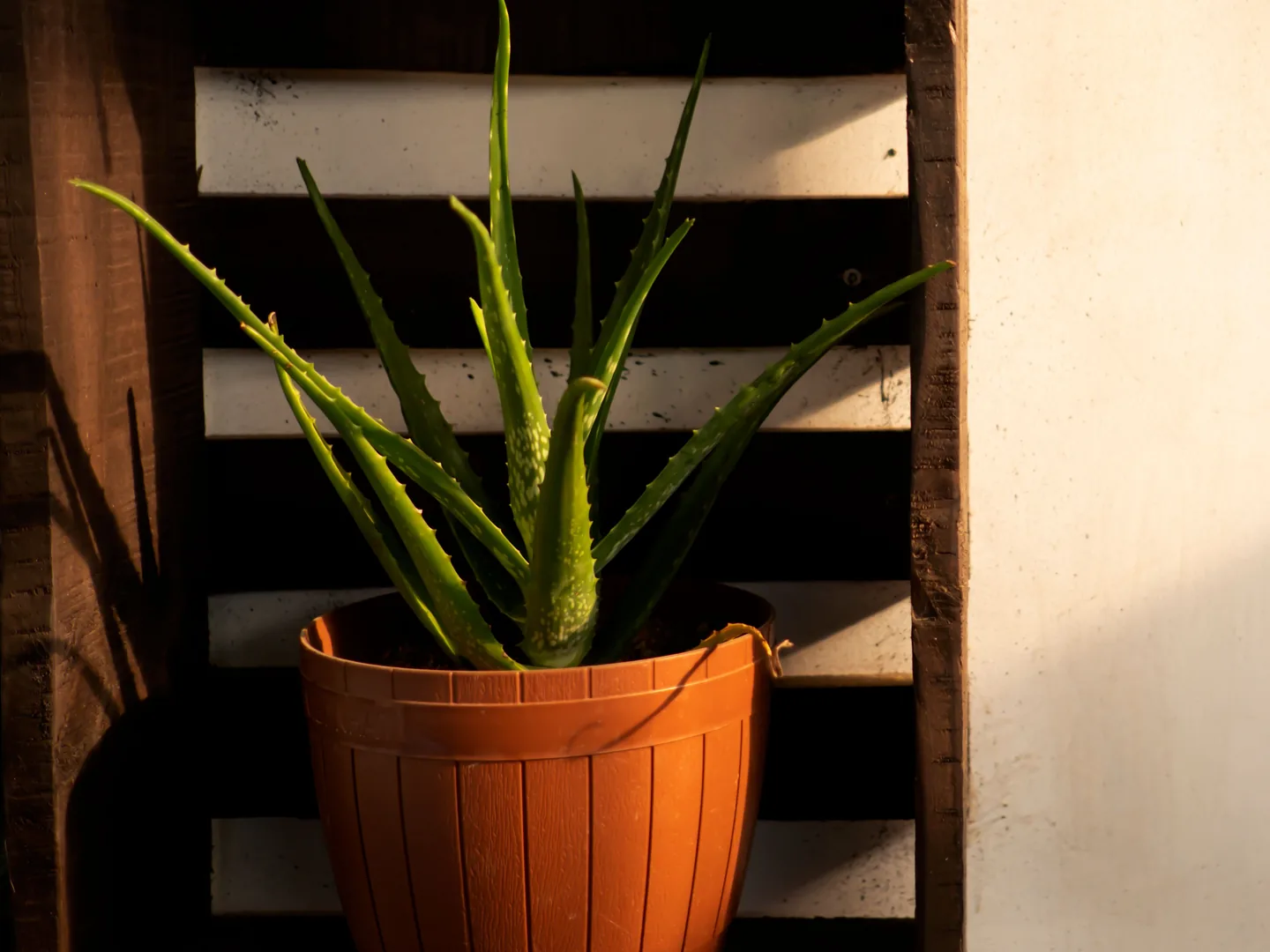
Photo: Duc Anh Nguyen, Pexels License, via Pexels (cropped and resized)
Light
Most aloe care guides ask for plenty of sun. The New York Botanical Garden notes that an aloe needs a window with at least six hours of sun a day; without extended direct light it stretches, loses its compact form and may topple over. NC State Extension suggests a south or west window, noting that most aloes need at least 6 hours of sun and grow best in full sun or very bright, indirect light. Penn State Extension suggests a sunny window with full sun to bright indirect light, and turning the pot now and then so all sides get light. University of New Hampshire Extension calls a south-facing windowsill perfect, with an unobstructed east or west window also working.
A few sources prefer gentler light. South Dakota State University Extension suggests bright, indirect sunlight and warns that direct sun can burn the leaves, and a Colorado State University Extension handout calls for high light, though not necessarily direct. What the sources agree on is that sudden changes cause harm: University of Florida IFAS Extension notes that an aloe moved outdoors can sunburn when it goes from low to bright light too quickly, so make any move into stronger sun gradual.
If no window is bright enough, Penn State Extension notes that grow lights are a good option. The New York Botanical Garden suggests a white fluorescent light 6 to 12 inches above the plant for at least 14 to 16 hours a day.
Watering
Penn State Extension advises erring on the side of underwatering: during the growing season, water thoroughly when the surface of the soil is dry, and never let the plant sit in water. Sources differ on how dry the soil should get: University of Florida IFAS Extension says to water when the top inch is dry, NC State Extension to let the soil dry completely, and the New York Botanical Garden to let it nearly dry. University of New Hampshire Extension notes that overwatering is one of the few things that will consistently kill aloe.
Water thoroughly so it runs out of the bottom of the pot, and empty the saucer: the New York Botanical Garden suggests checking back after 15 minutes to remove any water left in the tray, and keeping water out of the leaf rosette.
Water much less in winter. The New York Botanical Garden notes that the plant isn’t in active growth from October through February and prefers extended dry conditions, so water only often enough to keep the soil from drying out completely; Penn State Extension suggests keeping the soil barely moist so the leaves don’t shrivel; and Missouri Botanical Garden says to reduce watering to the minimum.
There is no reliable schedule. General succulent guides from University of Illinois Extension and Iowa State University Extension give every two to three weeks as a starting point, but Iowa State suggests checking that the soil is dry several inches down first. Pot size, light and season all change how fast the soil dries, so check the soil rather than the calendar.
Water quality can matter: the New York Botanical Garden notes that some aloes are sensitive to fluoride and may show brown spotting, and suggests rainwater or purified water if possible.
Soil and pots
Use a coarse, fast-draining mix. Penn State Extension suggests a store-bought cactus and succulent mix, or equal parts potting soil, sand and perlite or lava rock. The New York Botanical Garden suggests equal parts potting soil, peat and sand, calls commercial cactus mixes acceptable if not ideal, and advises avoiding mixes with fertilizer already added.
The pot must have a drainage hole (New York Botanical Garden; Penn State Extension). NC State Extension calls clay pots ideal; for houseplants in general, Clemson Extension notes that clay pots let the soil dry faster than plastic ones.
Repot only as needed. Penn State Extension suggests repotting about every two years to refresh the soil, in a container slightly larger than the old one, with 1 to 1.5 inches between the root ball and the edge of the pot. University of Florida IFAS Extension advises moving up no more than two pot sizes, because too large a container can hold too much moisture and lead to root rot. The New York Botanical Garden suggests repotting older plants in July or August and not setting the plant any deeper than it grew before, because burying the stem leads to rot.
Temperature and humidity
The New York Botanical Garden notes that aloes tolerate daytime temperatures of 60 to 75°F and nights of 50 to 60°F, and that spots near windows can be about 10 degrees colder than the center of the room in winter; an aloe chilled on a cold windowsill or in a draft will discolor. Sources differ on the minimum: University of New Hampshire Extension says not to grow aloe in a room that dips below 50°F, while Missouri Botanical Garden gives a winter minimum of 40°F. South Dakota State University Extension notes that 55 to 85°F closely resembles the plant’s natural environment. South Dakota State University Extension and Penn State Extension note that aloe can’t take frost, and University of Arizona Extension that it can be grown outdoors year-round in areas where there is no chance of freezing.
You can move an aloe outdoors for the summer. Penn State Extension notes that it must come back in before frost, and University of Arizona Extension before the first fall freeze; Missouri Botanical Garden suggests bringing it in before nights begin to dip below 50°F and protecting it from rain. Make the move to outdoor sun gradual to avoid sunburn (University of Florida IFAS Extension).
Humidity is not a concern: the New York Botanical Garden notes that aloes don’t need humidity and advises against misting, and Missouri Botanical Garden notes that the plant tolerates dry indoor air.
Feeding
Aloes need very little fertilizer, and sources differ on whether to feed at all. The New York Botanical Garden suggests feeding only during the growing season, March through September, with a balanced organic houseplant food at half strength once every one to three months, and avoiding high-nitrogen fertilizer. University of Arizona Extension suggests a light application of houseplant fertilizer in spring, and South Dakota State University Extension notes that no fertilizer is usually needed. Don’t feed in winter, when the plant is resting (New York Botanical Garden).
Pups and propagation
Aloe vera makes new plants from offsets, or pups, around the base of mature plants (Missouri Botanical Garden; University of Arizona Extension). University of Arizona Extension suggests removing them once they are a couple of inches tall, cutting them free with a clean, sharp knife if needed, and letting the cut dry for about a week before potting; roots should form in a month or so. The New York Botanical Garden suggests doing this in early summer, potting the pup in a well-draining mix, and giving it bright, indirect light and little water until it is established.
Don’t count on leaf cuttings. In an Ask Extension answer about broken aloe leaves, the expert notes that a leaf broken off an aloe vera will not root, and Iowa State University Extension and University of Illinois Extension list aloe under offsets or division only. Another Ask Extension answer, about a drooping aloe the expert suspected was overwatered, suggests that if rot is too far along, healthy remaining leaves are another option, so views differ; the pups are the method the Extension and botanical garden pages describe.
Flowers
Indoor aloes rarely bloom (University of Florida IFAS Extension). Missouri Botanical Garden notes that flowers appear only on mature plants, and on container plants only in optimum conditions such as a sunny window or a sunny spot outdoors. University of New Hampshire Extension notes that aloe can flower if it gets enough bright light, sending up tall spikes of tubular flowers.
Common problems
These are short summaries; check the signs before you change anything. Visual signs are clues, not proof of a cause. The New York Botanical Garden notes that too much water is the most frequent cause of succulent failure, so be careful about adding water to a plant that may already have too much.
Drooping or flat leaves
Some drooping is normal: the New York Botanical Garden notes that the older, outer leaves of a mature aloe vera naturally droop somewhat and sprawl away from the center. It names two other common causes. Too little sun leaves the leaves limp, flattened and stretched; overwatering or soggy soil, especially in winter, makes the plant sag, with leaves that look bleached and weak. Check the light first, then feel the soil and make sure the drainage hole isn’t blocked. If the soil stays wet or the base of the plant is soft, check the roots before watering again (see soft leaves and root rot).
Thin, curled or shriveled leaves
South Dakota State University Extension notes that too little water gives yellow, shriveled and puckered leaves, and that the plant should recover once it is watered again. For houseplants in general, Clemson Extension notes that chronic underwatering causes wilting and leaf curling. We found no aloe-specific source that explains leaf curling itself. For succulents in general, Iowa State University Extension warns that the signs of a plant growing too wet are often mistaken for underwatering, so more water makes things worse. Our suggested check before you water: if the soil is dry several inches down (the depth Iowa State University Extension suggests checking) and the leaves are firm at the base, water thoroughly; if the soil is damp, or the base or leaves are soft, check the roots instead (see soft leaves and root rot).
Yellow leaves
Yellowing can come from either end of the watering scale: South Dakota State University Extension links yellow, shriveled leaves to too little water, while for houseplants in general Clemson Extension notes that when the entire plant yellows, the most common cause is overwatering. Feel the soil before you decide: if the leaves are soft or the soil is still damp below the surface, check the roots (see soft leaves and root rot). Dry lower leaves on succulents are normal and can be removed (University of Illinois Extension, general).
Brown or dark spots
Several causes can look alike. The New York Botanical Garden notes that some aloes are sensitive to fluoride in tap water and may show brown spotting. For succulents in general, Iowa State University Extension notes that brown or tan patches are a common sign of sun scald, typically after a sudden move from low light into bright sun, and that the burned areas won’t recover. In one Ask Extension answer about black spots on an aloe vera, a plant pathologist listed bacterial disease, anthracnose and excess water as possible causes, judged excess water from irregular watering the most likely in that case, and suggested a lab sample only if a disease was still suspected. South Dakota State University Extension describes aloe rust as yellow spots that turn brown. The California Department of Food and Agriculture notes periodic detections on greenhouse-grown plants in cooler climates, including the US, and that the aloe rust fungus is a U.S. regulated plant pest; in the first published report of aloe vera rust in a US nursery, from Pennsylvania in 2021, the plants were destroyed. If you suspect it, isolate the plant and contact your local Extension office. Spots alone don’t confirm a cause.
Brown tips
University of New Hampshire Extension notes that aloes near drafty windows may show discolored foliage or damaged leaf tips. For houseplants in general, Clemson Extension lists hot, dry air, improper watering, insect feeding and salt buildup as causes of brown tips and margins.
Soft, mushy leaves and root rot
NC State Extension notes that overwatering can lead to root rot. For houseplants in general, University of Maryland Extension notes that root and crown rots cause yellowing, browning and dieback of the leaves, browning or blackening of the crown or roots, and wilting, and Clemson Extension notes that infected roots are brown to black and may be soft. Stop watering, and check the roots and the base of the plant; an Ask Extension answer about a drooping aloe the expert suspected was overwatered suggests cutting black, soft roots back to healthy tissue and repotting in fresh succulent mix. South Dakota State University Extension warns that root rot can be fatal if not caught early.
Red, purple or brownish color
Color changes can be a sign of stress. In an Ask Extension answer about one aloe that turned purple outdoors, the expert listed too much sun, temperature swings, overwatering, phosphorus deficiency and transplant shock as possible stressors, and expected the color to return to green once the plant was moved to a more protected spot. For succulents in general, the New York Botanical Garden notes that a red-brown tinge in summer may indicate more light than the plant can handle in a south-facing window, and its aloe guide notes that a chilled aloe will discolor.
Pests
Missouri Botanical Garden suggests watching for mealybugs and scale. The New York Botanical Garden notes that mealybugs can hide in the rosette or in the roots, and suggests removing any you see by hand after dabbing them with rubbing alcohol on a cotton swab, then checking the plant regularly. South Dakota State University Extension notes that insecticidal soap can control mealybugs; follow the product label. For houseplants in general, University of Maryland Extension notes that sticky honeydew is the main sign of soft scale, and that heavily infested plants are best discarded.
Is aloe vera safe for pets and people?
Pets: no. The ASPCA lists aloe (Aloe vera) as toxic to dogs, cats and horses, with saponins and anthraquinones as the toxic compounds. Signs include vomiting (not in horses), lethargy and diarrhea. Keep it out of reach, and if you think your pet has eaten some, call your veterinarian or the ASPCA Animal Poison Control Center at (888) 426-4435.
People: this guide covers growing the plant, not using it, and we don’t recommend preparing or eating any part of a houseplant aloe. The NIH National Center for Complementary and Integrative Health notes that aloe products can come from the inner-leaf gel or the latex in the outer leaf, that topical gel is generally well tolerated though it occasionally causes burning, itching or rash, and that aloe latex taken by mouth can cause abdominal pain, cramps and diarrhea. Missouri Botanical Garden advises that the sap should not be eaten. NCCIH advises anyone who takes medicine to talk with a health care provider before using aloe, and notes that aloe taken by mouth may be unsafe during pregnancy and while breastfeeding.
Frequently asked questions
How often should I water aloe vera?
There is no fixed schedule. Let the soil dry between thorough waterings during spring and summer, and water much less in winter (see Watering). General succulent guides suggest starting at every two to three weeks and checking the soil first.
Can aloe vera grow in low light?
Not well. The New York Botanical Garden notes that without enough sun an aloe stretches, flops and loses its compact shape. If you don’t have a sunny window, Penn State Extension notes that grow lights are a good option.
Can I grow a new aloe from a leaf?
Usually not. In an Ask Extension answer about broken aloe leaves, the expert notes that a leaf broken off an aloe vera will not root. Use the pups that grow around the base instead (see Pups and propagation).
Is every plant sold as aloe vera really aloe vera?
Not always. Wisconsin Extension notes that aloes sold in mixed cactus and succulent offerings are often labeled generically or misnamed. The New York Botanical Garden notes that only a limited number of aloe species stay small enough to be good houseplants. Aloe vera itself is not tiny: Penn State Extension notes that it can grow over 2 feet tall, and Missouri Botanical Garden gives 1 to 2 feet, noting that plants may grow as tall as 3 feet.
Sources
- New York Botanical Garden, Mertz Library: Aloe Houseplants (plant guide); propagating aloe offsets (FAQ); Succulents In Your Home (succulents in general).
- Missouri Botanical Garden: Aloe vera (Plant Finder).
- Penn State Extension: Aloe, a Hardy Houseplant (2024).
- NC State Extension Gardener Plant Toolbox: Aloe vera and Aloe.
- University of New Hampshire Extension: What should I know about growing aloe at home? (2019).
- South Dakota State University Extension: Aloe Vera: Houseplant How-To (2024).
- University of Arizona Cooperative Extension: Aloe vera, Backyard Gardener (2024).
- University of Florida IFAS Extension, Gardening Solutions: Aloe Vera.
- University of Wisconsin–Madison Extension: Small Aloes: Interesting, Colorful and Easy Succulents.
- Colorado State University Extension: Houseplants for Everyone (webinar handout, 2020).
- Iowa State University Extension and Outreach (succulents in general): Growing Succulents Indoors; Common Problems and Issues with Succulents; How to Propagate Succulents.
- University of Illinois Extension: low-maintenance succulents (2024, succulents in general); Houseplants: Propagation.
- Clemson Cooperative Extension, Home & Garden Information Center (houseplants in general): Houseplant Diseases & Disorders (HGIC 2251); Indoor Plants: Cleaning, Fertilizing, Containers & Light Requirements (HGIC 1450).
- University of Maryland Extension, Home and Garden Information Center (houseplants in general): Root Rots of Indoor Plants; Scale Insects on Indoor Plants.
- Ask Extension answers about aloes: broken aloe vera leaves (2018); a drooping aloe (2023); an aloe that changed color (2020); black spots on aloe vera (2022).
- California Department of Food and Agriculture: California Pest Rating Profile for Uromyces aloës (aloe vera rust) (2024).
- ASPCA Animal Poison Control: Aloe.
- NIH National Center for Complementary and Integrative Health: Aloe Vera (2025).
