
Plant Problems › Brown Tips and Edges
Brown, crispy leaf tips and edges can happen on any indoor plant, and Iowa State Extension notes that they are common on some species, such as spider plant and dracaena. Clemson Extension lists hot, dry air, improper watering, insect feeding and salt buildup among the causes, so start with how and where the plant is grown. Brown spots in the middle of the leaf are a different problem.
Quick answer
Causes to check:
- Dry air: brown tips, especially in winter. Fix this week
- Uneven watering: brown tips and edges after the mix dries out too long between waterings. Fix this week
- Too much fertilizer or salt buildup: brown tips and edges, sometimes with a white crust on the mix or pot. Fix this week
- Chlorine or fluoride in the water: brown tips on sensitive plants such as spider plant, dracaena, prayer plant and calathea. Fix this week
- Too much sun, heat or drafts: scorched, brown edges on leaves near a sunny window, heater or vent. Fix this week
- Wet mix and rotting roots: browning with wilting while the mix stays wet. Act soon
Labels show how quickly to act if a cause is confirmed. They are not a diagnosis; check the signs in each section first.
First checks
- Feel the potting mix. Bone dry, soggy or evenly moist? See watering.
- Look for a white crust on the surface of the mix or the rim of the pot. Clemson Extension notes that white to gray crusty deposits there are a sign of salt buildup; see fertilizer and salts.
- Check where the plant sits: near a heater or vent, in a hot, sunny window or in a cold draft? See sun, heat and drafts.
- Think about the season and your water: dry indoor air is common, especially in winter, and some plants react to chlorine or fluoride in tap water.
Brown tips or brown edges?
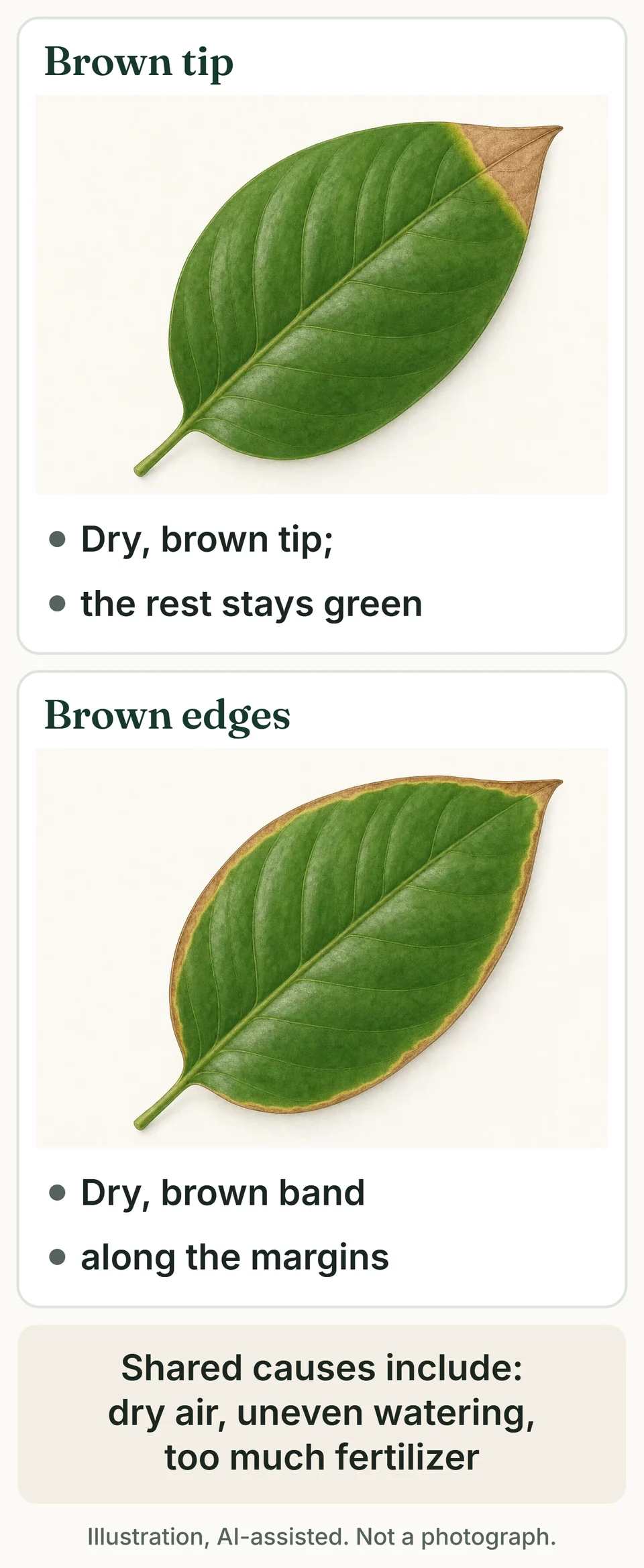
Tips and edges share most of their causes. Iowa State Extension links dry air and inconsistent watering to brown leaf tips and edges, and University of Maryland Extension describes the typical sign of too much fertilizer as browning or dieback of the leaf tips and margins. So the pattern alone won’t tell you which cause it is; the checks above will.
Brown or black spots scattered in the middle of the leaf are a different problem, with causes of their own.
Dry air
How urgent: Fix this week
Iowa State Extension notes that the most likely cause of brown tips is low humidity, which is often low in homes, especially in winter. It also notes that most indoor plants grow best at 40 to 50% humidity, while homes can drop to 10% in winter. University of California IPM, by contrast, names too much fertilizer, salt buildup and too-dry or too-wet soil as the usual causes, with low humidity among the other possible ones, so check the mix as well.
What to do
- Raise the humidity around plants that need it: Iowa State Extension suggests a humidifier, a pebble tray, a terrarium, or grouping plants together.
- On a pebble tray, keep the bottom of the pot above the water: Iowa State Extension warns that otherwise the mix never dries out and the roots can rot.
- Don’t rely on misting: Iowa State Extension notes that it doesn’t raise humidity for more than a few minutes.
Watering: too dry or too wet
Iowa State Extension notes that inconsistent watering, in particular letting plants dry out too long between waterings, turns leaf edges and tips brown. University of California IPM lists excessively dry or wet soil among the causes of brown leaf tips, so check which one it is before you water.
How to tell
- Too dry Fix this week: the mix is dry all the way down and the pot feels light. Missouri Botanical Garden notes that too little water can blight leaf margins and make lower leaves turn brown, dry up and drop. If the plant is also wilting, water it now: Missouri Botanical Garden warns that a dry, wilted plant can die suddenly.
- Too wet Act soon: the mix stays wet and the plant wilts. University of Maryland Extension lists yellowing, browning and dieback of leaves among the symptoms of root rot, and Clemson Extension notes that rotting roots are brown to black and may be soft.
What to do
- If the mix is dry, water thoroughly until water runs out of the drainage hole, then empty the saucer. If very dry mix won’t take up water, Clemson Extension suggests watering again half an hour later or setting the pot in a sink or bucket of water, then taking it out once the surface is moist and letting it drain completely. From then on, for most plants, water when the top two inches are dry (University of Maryland Extension); succulents and cacti need far less water, and Clemson Extension notes that some plants prefer moister conditions.
- If the mix is wet, don’t water. Check the roots, and let the mix dry before you water again.
Too much fertilizer or salt buildup
How urgent: Fix this week
University of Maryland Extension notes that high salt levels come from too much fertilizer, too-frequent feeding or concentrates used incorrectly, and that the typical symptoms are browning or dieback of the leaf tips and margins. Symptoms can also include reduced growth, lower leaf drop, dead root tips and wilting.
How to tell
- Brown tips and edges.
- A white crust on the surface of the mix or salt deposits on the outside of the pot (University of Maryland Extension). Clemson Extension warns not to confuse a salt crust with white or yellow, mold-like growth from soil fungi.
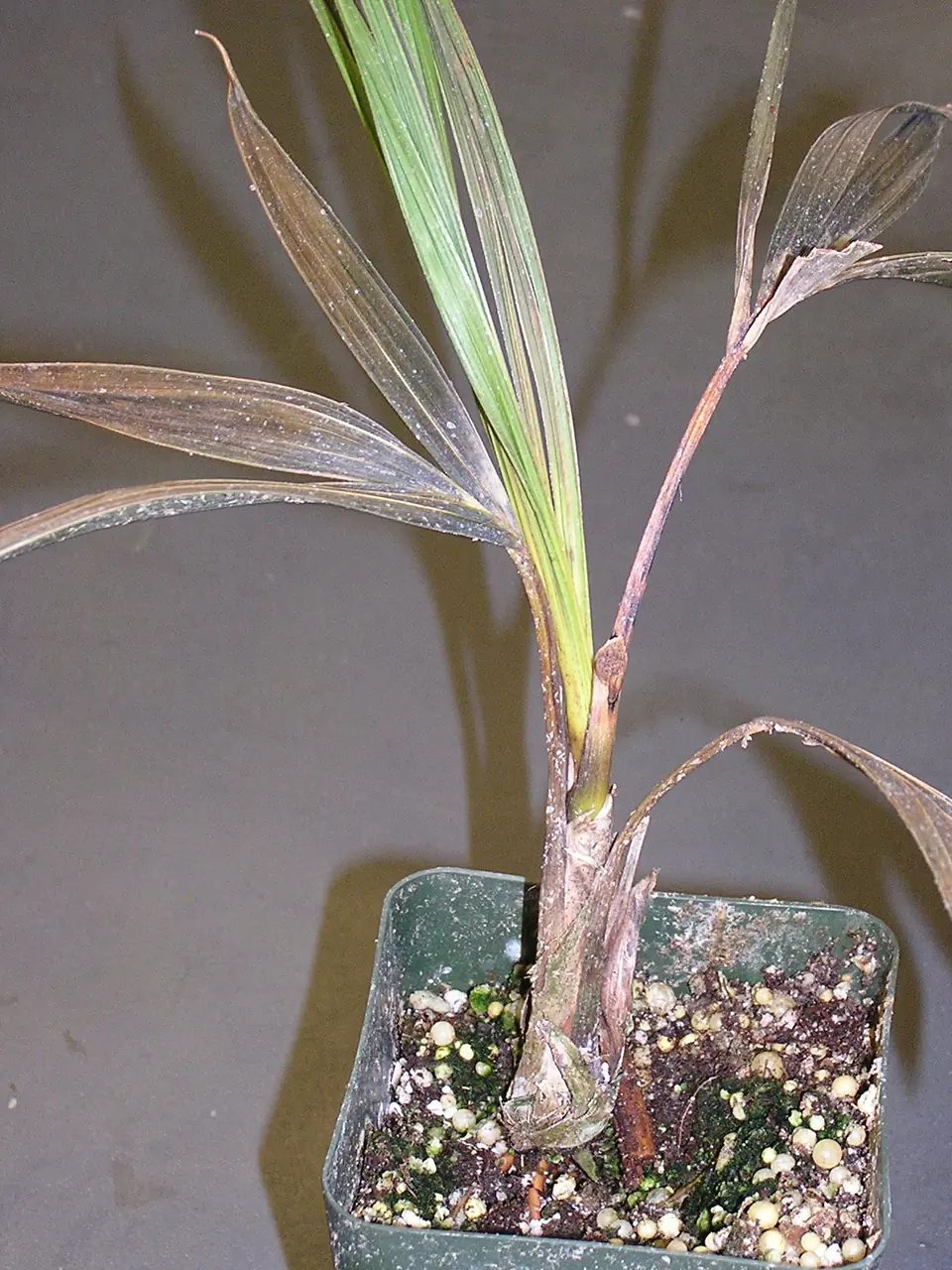
Photo: Scot Nelson, CC0, via Flickr (cropped and resized)
What to do
- Flush the mix if the pot drains freely: University of Maryland Extension suggests letting clear water run out of the bottom of the pot, repeated several times, each time with at least as much water as the pot holds. For small pots with a lot of salt, replace the potting mix.
- Feed less: Iowa State Extension advises fertilizing only while plants are actively growing, and mixing all-purpose fertilizers at half or quarter strength for houseplants.
Chlorine or fluoride in the water
How urgent: Fix this week
Iowa State Extension notes that too much chlorine and other chemicals, such as fluoride, can brown leaf tips, especially over a long time on sensitive plants such as spider plant, ti plant, dracaena, prayer plant and calathea, and suggests using a different water source if you suspect it.
What to do
- Try another water source for sensitive plants, such as rainwater (University of Maryland Extension).
- Avoid softened water: Clemson Extension notes that it adds sodium and chloride to the potting mix.
- For chlorine, University of Maryland Extension suggests drawing water the day before; a day’s evaporation should clear it of chlorine.
Sun, heat and drafts
How urgent: Fix this week
Missouri Botanical Garden notes that bright light can cause brown-tipped, scorched margins on plants that prefer low light, and Clemson Extension that hot, dry air can brown leaf tips and margins. University of California IPM adds too much sun or heat through a window and a drafty setting, and Illinois Extension lists cold drafts among the causes of brown leaf tips.
What to do
- Move the plant away from heaters, hot air vents, cold or drafty windows and doors.
- For too much sun, move it farther from the window or filter the light, and change light levels gradually: Iowa State Extension advises moving plants to a new light level over several weeks.
Other causes
- Crowded roots: University of Maryland Extension notes that pot-bound plants can show tip dieback or browning along the edges because the root mass can’t take in enough water.
- Pests: Clemson Extension lists insect feeding among the causes of brown tips and edges; check under the leaves.
- Disease: Clemson Extension notes that anthracnose, a fungal disease, turns leaf tips yellow, then tan, then dark brown, but that diseases are not common on most houseplants grown indoors.
Should you cut off brown tips?
You can. Iowa State Extension notes that trimming the brown parts off with scissors improves the plant’s appearance, but that new browning will appear if the cause isn’t fixed. Judge your fix by the new leaves.
When to act quickly
- Browning with wilting while the mix is wet, or a soft, dark stem base: stop watering and check the roots today. See watering.
- Wilting while the mix is dry all the way down and the pot feels light: water thoroughly now; Missouri Botanical Garden warns that a dry, wilted plant can die suddenly. See watering.
- Many leaves browning soon after a heavy feeding: if the pot drains freely and the mix isn’t soggy, flush it with clear water; in a small pot, replace the mix. See fertilizer and salts.
Brown tips by plant
Guides for brown tips on specific plants:
Frequently asked questions
Why are my plant leaves turning brown and crispy?
Iowa State Extension names low humidity as the most likely cause of brown tips and edges, and also lists inconsistent watering, too much fertilizer and water quality. University of California IPM instead names too much fertilizer, salt buildup and too-dry or too-wet soil as the usual causes. Check the potting mix and look for a white crust before you change anything.
Do brown tips mean I’m overwatering?
Not necessarily. University of California IPM lists both excessively dry and excessively wet soil among the causes of brown leaf tips. Feel the mix: if it stays wet and the plant wilts, check the roots.
Which plants get brown tips most?
Iowa State Extension notes that brown tips are common on spider plant and dracaena, and that spider plant, ti plant, dracaena, prayer plant and calathea are sensitive to chlorine and fluoride in water.
Not sure what is wrong? Go back to the first checks.
Sources
- Iowa State University Extension and Outreach: Why does my houseplant have brown leaf tips and edges?; How to Care for Houseplants; Diagnosing Houseplant Problems from Improper Environmental Conditions.
- University of Maryland Extension, Home & Garden Information Center: Fertilizer Toxicity or High Soluble Salts on Indoor Plants; Watering Indoor Plants; Root Rots of Indoor Plants; Pot-Bound Indoor Plants.
- Clemson Cooperative Extension, Home & Garden Information Center: Houseplant Diseases & Disorders (HGIC 2251); Indoor Plants – Watering (HGIC 1459).
- University of California Statewide IPM Program: Pest Notes: Houseplant Problems (UC ANR Publication 74172).
- Missouri Botanical Garden: Indoor Plants or Houseplants (factsheet); Environmental Problems of Indoor Plants.
- University of Illinois Extension: Troubleshooting (houseplants).
