
Plant Care Guides › Pothos Care
Pothos (Epipremnum aureum), also called devil’s ivy or golden pothos, is a tropical climbing vine and one of the most popular houseplants in North America (University of Wisconsin–Madison Extension). It is grown for its heart-shaped leaves, which can be plain green, chartreuse, or streaked with yellow or white depending on the variety. Pothos tolerates lower light, but Penn State Extension notes that too much water leads to root rot, one of only a few problems with this plant. This guide covers light, water, soil, temperature, feeding and pruning, with a short guide to common problems. Where care guides disagree, we show both views.
Pothos care at a glance
- Light: bright, indirect light is best; tolerates lower light, but variegated leaves may lose some color there; avoid direct sun
- Water: water thoroughly, then let the top of the soil dry before watering again; never leave the pot standing in water
- Soil and pot: an airy, well-draining potting mix in a pot with a drainage hole
- Temperature: 65 to 80°F is ideal (New York Botanical Garden); keep above 55°F and away from cold drafts
- Humidity: prefers 50 to 70% but tolerates average household humidity (Clemson Extension)
- Feeding: a houseplant fertilizer during spring and summer; none in winter, for most sources
- Pet safety: toxic to dogs and cats (ASPCA)
- Difficulty: easy, as long as it isn’t overwatered
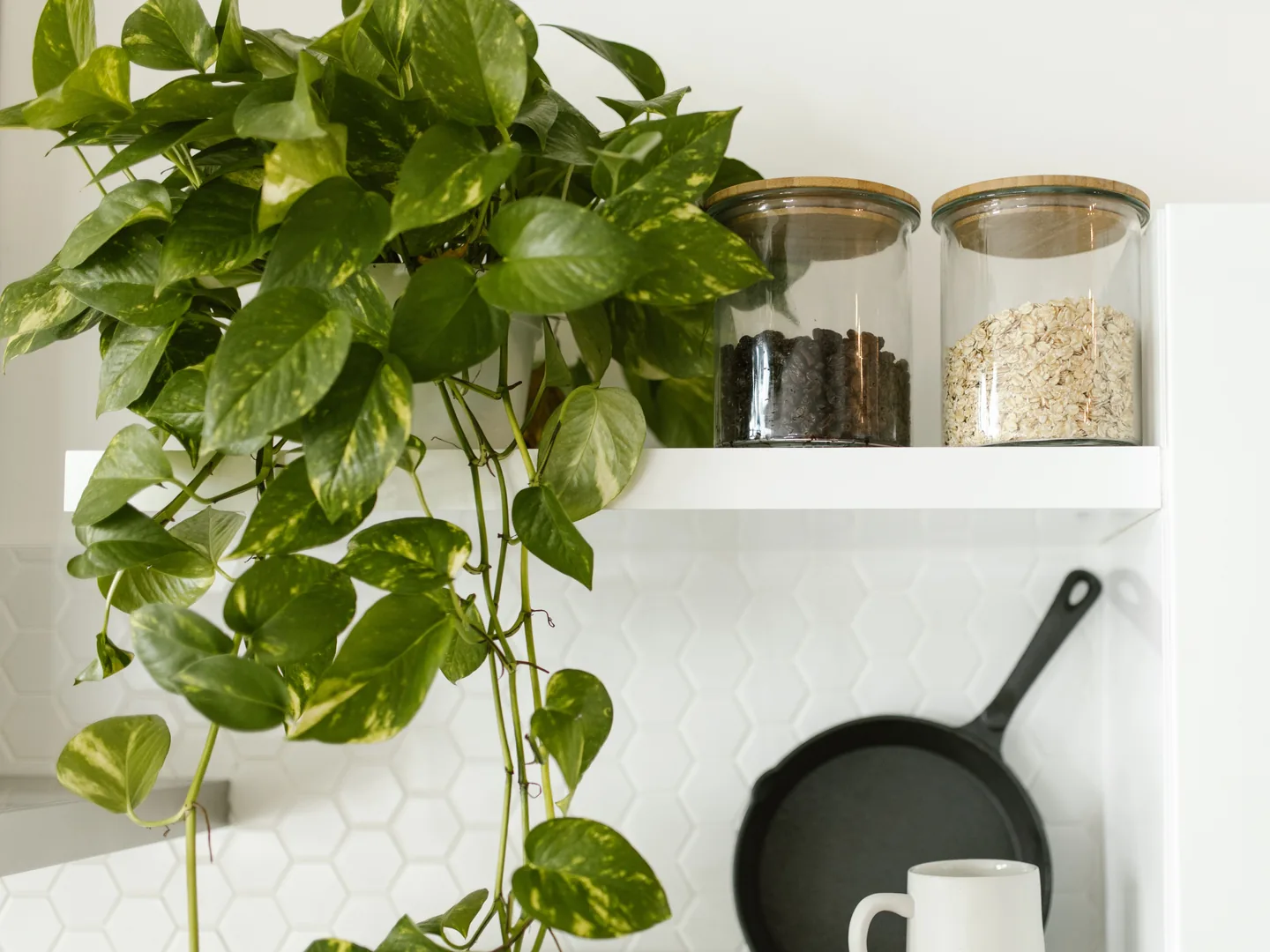
Photo: RDNE Stock project, Pexels License, via Pexels (cropped and resized)
Light
Pothos does best in bright, indirect light, and it tolerates lower light (Clemson Extension; NC State Extension). The New York Botanical Garden notes that pothos can survive poor light but may slowly decline in health and will lose its attractive variegation, and Clemson Extension, University of Wisconsin–Madison Extension and NC State Extension all note that low light can cause variegated leaves to lose color. In an answer about a pothos, University of Maryland Extension notes that ceiling fluorescents alone are usually not enough for good long-term growth, and that a grow light or moving the plant closer to the light may help. Penn State Extension notes that the leaves grow toward the light and suggests turning the pot weekly for more balanced growth.
Avoid direct sun. Penn State Extension notes that direct sun will yellow the leaves, University of Wisconsin–Madison Extension that pothos does not tolerate much direct sunlight, and the New York Botanical Garden that cultivars with light-colored leaves burn easily and do better in indirect, medium light. A University of Florida IFAS guide for commercial growers describes burned, dead patches confined to the variegated areas of the leaf from high light or heat, and notes that those leaves cannot recover. Missouri Botanical Garden is more permissive and also allows part sun with protection from afternoon sun. Leaf color fades if the light is too bright as well as too dim (New York Botanical Garden).
Watering
Overwatering is the main risk. Penn State Extension notes that pothos is better kept too dry than too wet, and in an answer comparing pothos with heartleaf philodendron, University of Maryland Extension notes that pothos is the more sensitive of the two to overwatering or staying too wet.
Sources differ on how dry the soil should get. University of Wisconsin–Madison Extension suggests letting the plant dry out slightly and watering when the soil surface is dry; the New York Botanical Garden suggests letting the top of the soil dry between waterings while the plant is growing; and in an answer about a pothos, University of Maryland Extension suggests letting the soil get somewhat dry about an inch or two deep, depending on pot size, without letting the plant wilt. Clemson Extension’s quick guide goes further and says to let the soil dry completely, while Missouri Botanical Garden is the outlier and suggests keeping the soil consistently moist during the growing season. When you do water, water thoroughly so that the water reaches all the roots (Clemson Extension).
Never leave the pot standing in water. The New York Botanical Garden suggests checking back about 15 minutes after watering and emptying any water left in the saucer; University of Maryland Extension notes that water left there can soak back into the root ball and suffocate the roots.
Water less in winter. In the low light of winter, the New York Botanical Garden suggests watering only as often as needed to keep the soil from drying out completely, and notes that a pothos in brighter light needs more water than one in a dimmer spot. Before you water at any time of year, feel the soil: if the leaves droop but the soil is still wet, don’t add water; check the roots instead (see Drooping).
Soil, pots and repotting
Use an airy, well-draining potting mix (Clemson Extension); Penn State Extension suggests a good-quality soilless mix that drains well. Keep the plant in a pot that drains from the bottom (New York Botanical Garden). For houseplants in general, University of Maryland Extension advises against filling the bottom of the pot with gravel.
Penn State Extension and the New York Botanical Garden suggest repotting in spring into a pot one size larger, about once a year; Clemson Extension says once every year or two, depending on growth, and lists roots growing through the drainage holes and an overcrowded, root-bound plant as signs that it’s time. To keep a large plant in the same pot, Penn State Extension suggests taking it out, trimming some roots and cutting back up to one-third of the length of the vines. It also notes that too much water after repotting adds stress, so water thoroughly once and then wait until the top of the soil dries (University of Maryland Extension, houseplants in general).
Temperature and humidity
Pothos likes warmth. The New York Botanical Garden gives 65 to 80°F as ideal and advises not keeping the plant below 55°F, letting it rest at around 60°F in winter if possible; Clemson Extension gives 60 to 70°F at night and 70 to 85°F during the day; and Penn State Extension suggests average room temperatures between 60 and 80°F. University of Wisconsin–Madison Extension notes that pothos does best between 70 and 90°F, in filtered light with high humidity, but survives a wide range of conditions. Clemson Extension advises keeping the plant away from air-conditioning vents in summer and from windowsills and heating vents in winter. Cold can leave marks: University of Wisconsin–Madison Extension notes that low temperatures or an abrupt drop from very high temperatures can cause scattered brown patches, usually in the center of the leaf, and a University of Florida IFAS guide for commercial growers ties those patches to several hours at 33 to 40°F.
Clemson Extension notes that pothos prefers 50 to 70% humidity but tolerates the 30 to 60% of an average home, and that a humidifier can help; NC State Extension also suggests a humidifier or a tray of wet pebbles. Sources disagree about misting: the New York Botanical Garden suggests misting daily if leaf tips start to brown, while University of Maryland Extension, in an answer about a pothos, advises against misting, because it doesn’t raise humidity enough or for long, and wet leaves can let disease spores infect more easily.
University of Wisconsin–Madison Extension notes that pothos is hardy only in zones 10 to 12, so in colder regions such as the Midwest it is always grown as a houseplant or seasonal annual. In Florida, University of Florida IFAS predicts pothos to be a high invasion risk and advises keeping it indoors rather than planting it outside.
Feeding
Feeding advice varies. University of Wisconsin–Madison Extension and NC State Extension suggest fertilizing every other month except in winter; for yellow leaves caused by low fertility, Clemson Extension suggests a houseplant fertilizer every other month during spring and summer. The New York Botanical Garden suggests a balanced fertilizer at half strength every two weeks from March to September only. Penn State Extension is the outlier: it suggests feeding every two weeks most of the year and monthly through the winter. Most sources skip winter feeding. For houseplants in general, Iowa State University Extension suggests using fertilizers at half or quarter strength indoors, and only while plants are actively growing. Too much fertilizer can cause problems too: University of Wisconsin–Madison Extension notes that salt buildup from excess fertilizer can blacken leaf margins or tips.
Pruning and long, bare vines
Long vines with most of their leaves at the ends are normal for an older pothos: University of Wisconsin–Madison Extension and NC State Extension note that older leaves yellow and drop off over time, leaving most of the leaves at the ends of the vines. For houseplants in general, University of Maryland Extension notes that low light also causes spindly, lanky growth. Pruning keeps the plant full. Penn State Extension suggests shortening a vine with sharp scissors just above a node, or removing a whole vine and leaving a 2-inch stub, and University of Wisconsin–Madison Extension notes that plants can be cut back to 2 inches from the soil line if necessary. The New York Botanical Garden suggests trimming in spring to control size. For a fuller pot, University of Wisconsin–Madison Extension suggests planting several rooted cuttings together.
Pothos can also climb. Clemson Extension suggests a moss pole or wooden rod, and NC State Extension notes that with a support to climb and enough light, the plant will begin to produce large, mature leaves. Wipe the leaves occasionally with a soft cloth to remove dust (NC State Extension). University of Wisconsin–Madison Extension notes that pothos does not flower in cultivation, and Missouri Botanical Garden that flowers rarely appear on indoor plants.
Propagation
Pothos roots easily from stem cuttings, which need at least one node (Clemson Extension). Cuttings root in soil or water (Clemson Extension), or in water or vermiculite (University of Wisconsin–Madison Extension), though the New York Botanical Garden roots them in potting mix rather than water, because water-grown roots are hard to move into soil, and University of Illinois Extension notes, for houseplants in general, that roots formed in water often adapt less easily to potting mix. Penn State Extension notes that cuttings root more readily from spring through summer.
Varieties and look-alikes
Common varieties include ‘Golden’, with yellow variegation; ‘Marble Queen’, with white variegation; ‘Jade’, plain dark green; and ‘Neon’, bright chartreuse (University of Florida IFAS). Varieties differ in light needs: Clemson Extension notes that ‘Marble Queen’ needs more light than other varieties, that ‘Pearls and Jade’ needs lots of light to keep its intense coloring and ‘Snow Queen’ lots of bright, indirect light, while ‘Neon’ tolerates lower light. In a 3-month University of Florida IFAS trial in a growth room, ‘Pearls and Jade’ kept its color at a low light level, so these differences are a guide rather than a rule.
Pothos is often confused with heartleaf philodendron. Clemson Extension, Penn State Extension and NC State Extension note that pothos leaf stalks have a groove, and Clemson Extension that philodendron leaf stalks are smooth; Penn State Extension notes that new philodendron leaves emerge from a protective sheath that dries and drops off, while pothos leaves emerge without one. The difference matters for watering: in an answer comparing the two, University of Maryland Extension notes that pothos is the more sensitive to overwatering. Satin pothos (Scindapsus) isn’t a true pothos; Clemson Extension notes that it is more prone to pests and disease and less tolerant of overwatering.
Common problems
These are short summaries; check the signs before you change anything. Visual signs are clues, not proof of a cause, and in an answer about a pothos, University of Maryland Extension notes that stress from soil moisture or temperature can sometimes look convincingly like pest or disease damage.
Yellow leaves
University of Wisconsin–Madison Extension notes that older leaves turn yellow and drop off naturally, and in an answer about a pothos, University of Maryland Extension that gradual yellowing and shedding of the oldest leaves is normal for indoor plants. Beyond that, Clemson Extension notes that yellow leaves are often caused by overwatering or low fertility, and the New York Botanical Garden notes that yellowing, falling leaves and rotting stems indicate overwatering or soil that holds too much water. Our guide to pothos yellow leaves walks through each cause and how to tell them apart.
Brown spots and black patches
Several causes can look alike. University of Wisconsin–Madison Extension notes that blackening of the leaf margins or tips can come from overwatering, from too little water, or from excess fertilizer, often with yellowing leaves, and NC State Extension also links blackened margins to overwatering. The New York Botanical Garden notes that brown edges together with brown spots appear when the root ball dries out during the growing season. Scattered brown patches in the center of the leaf can follow cold (see Temperature), and burned patches confined to the variegated areas can follow strong light or heat (see Light). Missouri Botanical Garden suggests watching for fungal leaf spot and botrytis. In an answer about a pothos, University of Maryland Extension could not tell from photos what caused the spots, noted that damaged areas won’t heal, and suggested clipping off the worst-spotted leaves if that doesn’t strip the plant too much. Spots alone don’t confirm a cause; feel the soil, and if it stays wet, check the roots (see Root rot).
Brown tips and edges
Clemson Extension notes that leaf scorch and tip dieback are often caused by low humidity or intense light. The New York Botanical Garden ties brown edges together with brown spots to a root ball that has dried out during the growing season, and University of Wisconsin–Madison Extension lists overwatering, too little water and excess fertilizer as causes of blackened tips and margins. For houseplants in general, Iowa State University Extension names low humidity as the most likely cause, along with letting plants dry out too long between waterings, and University of Maryland Extension names a buildup of salts from fertilizer. Brown tips alone don’t confirm a cause; check the soil moisture, the light and your feeding before you change anything.
Drooping or wilting
Drooping can mean the plant needs water: Penn State Extension notes that too little water may make the leaves droop temporarily. But for houseplants in general, Iowa State University Extension notes that wilting can come from either too little or too much water, and University of Maryland Extension that rotted roots can make a plant wilt even when the soil is wet. So feel the soil first. If it is dry and the pot feels light, water thoroughly. If it is still wet, don’t add water; check the roots (see Root rot). A root-bound plant can also wilt because its pot holds too little water for all its roots (Clemson Extension, houseplants in general).
Root rot
Clemson Extension notes that root rot is caused by overwatering or poorly draining soil, and University of Wisconsin–Madison Extension that root rot, with brown or missing roots, is most often due to overwatering. To check, slide the plant out of its pot. For houseplants in general, University of Maryland Extension describes roots with Pythium root rot as brown to black and soft, with an outer layer that pulls away easily; root color varies, so judge firmness as well as color. For houseplants in general, Clemson Extension suggests that if only a few roots are affected, you cut them out and repot in sterile soil.
Dying or declining pothos
No single cause explains a dying pothos. Check the basics in this order: the soil moisture and roots, the light and the temperature. If the plant is beyond saving, you can start over with cuttings: University of Wisconsin–Madison Extension notes that with a severe pest infestation it is often better to discard the plant and start over with clean plants or cuttings, and for houseplants with root rot, University of Maryland Extension advises throwing away severely infected plants and taking stem cuttings only from healthy tissue.
Pests
Clemson Extension notes that pothos is generally pest-free indoors but can get spider mites and mealybugs, and University of Wisconsin–Madison Extension names mealybugs and scale as the most common pests on pothos in homes. Mealybugs look like white, cottony masses, often where the leaves join the stem, on the undersides of leaves and even on the roots (University of Wisconsin–Madison Extension). For houseplants in general, Iowa State University Extension suggests spot-treating a few mealybugs with a cotton swab dipped in rubbing alcohol; UC Statewide IPM advises 70% or weaker alcohol, tested on a small part of the plant one to two days first, and cautions that rubbing alcohol is flammable. Not every source agrees with home remedies: in an answer about a pothos, University of Maryland Extension advises against sprays made with dish soap or rubbing alcohol, which can damage a plant that is sensitive or already stressed. University of Wisconsin–Madison Extension notes that spider mites can be controlled with thorough cleaning and frequent applications of insecticidal soap. Fungus gnats prefer moist soil, so they are a sign of overwatering (Iowa State University Extension, houseplants in general).
Is pothos safe for pets and people?
Pets: no. The ASPCA lists golden pothos as toxic to dogs and cats because of insoluble calcium oxalates, with oral irritation, intense burning of the mouth, tongue and lips, drooling, vomiting and difficulty swallowing as signs. If you think your pet has eaten some, call your veterinarian or the ASPCA Animal Poison Control Center at (888) 426-4435.
People: the Missouri Poison Center notes that pothos can be an irritant: chewing the leaves causes irritation, drooling and redness almost right away, and if someone eats enough of the plant, swelling of the mouth and throat can make swallowing and breathing difficult, but this is rare. The sap can also cause a skin rash. If someone eats a small amount, it suggests wiping out the mouth with a soft, wet cloth, giving some cool water to drink, and washing exposed skin with soap and water. If the person collapses, has a seizure, has trouble breathing or can’t be awakened, call 911 immediately (National Capital Poison Center). If problems start or you have questions, the Missouri Poison Center advises calling Poison Control (in the US) right away at 1-800-222-1222; the National Capital Poison Center gives the same number for anyone who eats a poisonous plant. Clemson Extension advises keeping pothos out of reach of children and pets.
Frequently asked questions
How often should I water a pothos?
There is no fixed schedule. Water when the top of the soil has dried, and less often in winter and in dimmer spots (New York Botanical Garden); when you water, water thoroughly (Clemson Extension). Feel the soil first, and never leave water standing in the saucer (see Watering).
Can pothos grow in low light?
It tolerates lower light (Clemson Extension; NC State Extension), but it may slowly decline there (New York Botanical Garden), and variegated varieties may lose some of their coloring (Clemson Extension). Bright, indirect light keeps it growing well.
Why is my pothos losing its variegation?
Too little light can cause it: several Extension services note that low light can cause loss of variegation, and the New York Botanical Garden suggests moving the plant to brighter, indirect light for better color. Very bright light can also fade leaf color (New York Botanical Garden), and a University of Florida IFAS guide for commercial growers also lists magnesium deficiency and low fertilizer rates as causes of new leaves lacking variegation.
What is the difference between pothos and philodendron?
Pothos leaf stalks have a groove (Clemson Extension; Penn State Extension), while heartleaf philodendron leaf stalks are smooth (Clemson Extension), and new philodendron leaves emerge from a protective sheath (Penn State Extension). In an answer comparing the two, University of Maryland Extension notes that pothos is the more sensitive to overwatering.
Sources
- Clemson Cooperative Extension, Home & Garden Information Center: How to Grow Pothos Indoors (HGIC 1568, 2026); Houseplant Diseases & Disorders (houseplants in general).
- University of Wisconsin–Madison Extension: Pothos, Epipremnum aureum.
- Penn State Extension: Pothos as a Houseplant (2025).
- NC State Extension Gardener Plant Toolbox: Epipremnum aureum.
- New York Botanical Garden, Mertz Library: Pothos (plant guide, 2026); pothos propagation answer (2024).
- Missouri Botanical Garden: Epipremnum aureum (Plant Finder).
- University of Florida IFAS Extension: Cultural Guidelines for Commercial Production of Interiorscape Epipremnum (ENH894, for commercial growers); New Florida Foliage Plant Cultivar: Pothos ‘Pearls and Jade’ (ENH1180, 2011); Pothos (Florida Master Gardener plant ID).
- University of Maryland Extension, Home and Garden Information Center: answers on Ask Extension about pothos, yellowing and spotted leaves (2023) and pothos and philodendron watering (2025); Root Rots of Indoor Plants, Potting and Repotting Indoor Plants, Winter Indoor Plant Problems, Low Light Impacts on Indoor Plants and Fertilizer Toxicity or High Soluble Salts in Indoor Plants (houseplants in general).
- Iowa State University Extension and Outreach: Diagnosing Houseplant Problems Related to Poor Culture, Why is my houseplant wilting?, Why does my houseplant have brown leaf tips and edges? and Diagnosing Houseplant Problems Caused by Insect Pests (houseplants in general).
- University of Illinois Extension: Houseplant propagation (houseplants in general).
- UC Statewide IPM Program: Houseplant Problems (Pest Notes 74172; houseplants in general).
- ASPCA Animal Poison Control: Golden Pothos.
- Missouri Poison Center: Devil’s Ivy.
- National Capital Poison Center: Poisonous and non-poisonous plants: an illustrated list; First aid guidelines.
