
Plant Care Guides › Orchid Care
Orchid care depends on the kind of orchid. Iowa State University Extension notes that there is no universal watering schedule, because needs vary with the species, the plant’s size, light, temperature, humidity, potting mix, container and season. This guide is written for moth orchids (Phalaenopsis), which grow upward from a single central stem and which the American Orchid Society calls easy to grow because they enjoy the same temperatures we do. Moth orchids are “low” light orchids, and Clemson Extension describes them as one of the most adaptable orchids to indoor light. A short section near the end covers other common orchids, which need different care. Where care guides disagree in ways that matter for your plant, we show both views.
Moth orchid care at a glance
- Light: bright, indirect light; an east window is ideal, and most sources shade a south or west window with a sheer curtain
- Water: water thoroughly when the mix is nearly dry, but don’t let it dry out completely; water in the morning and never leave the pot standing in water
- Potting mix: medium-grade orchid bark (or sphagnum moss, which stays wet longer); never regular potting soil
- Temperature: nights above 60°F and days of 70 to 80°F or higher (American Orchid Society); other sources’ ranges vary
- Humidity: sources suggest anywhere from 40 to 80%; moth orchids tolerate dry winter air better than many orchids (University of Illinois Extension)
- Feeding: a weak orchid fertilizer, regularly; sources differ on how often
- Reblooming: enough light and, for many moth orchids, a few weeks of cooler nights in fall
- Pet safety: non-toxic to dogs and cats (ASPCA)
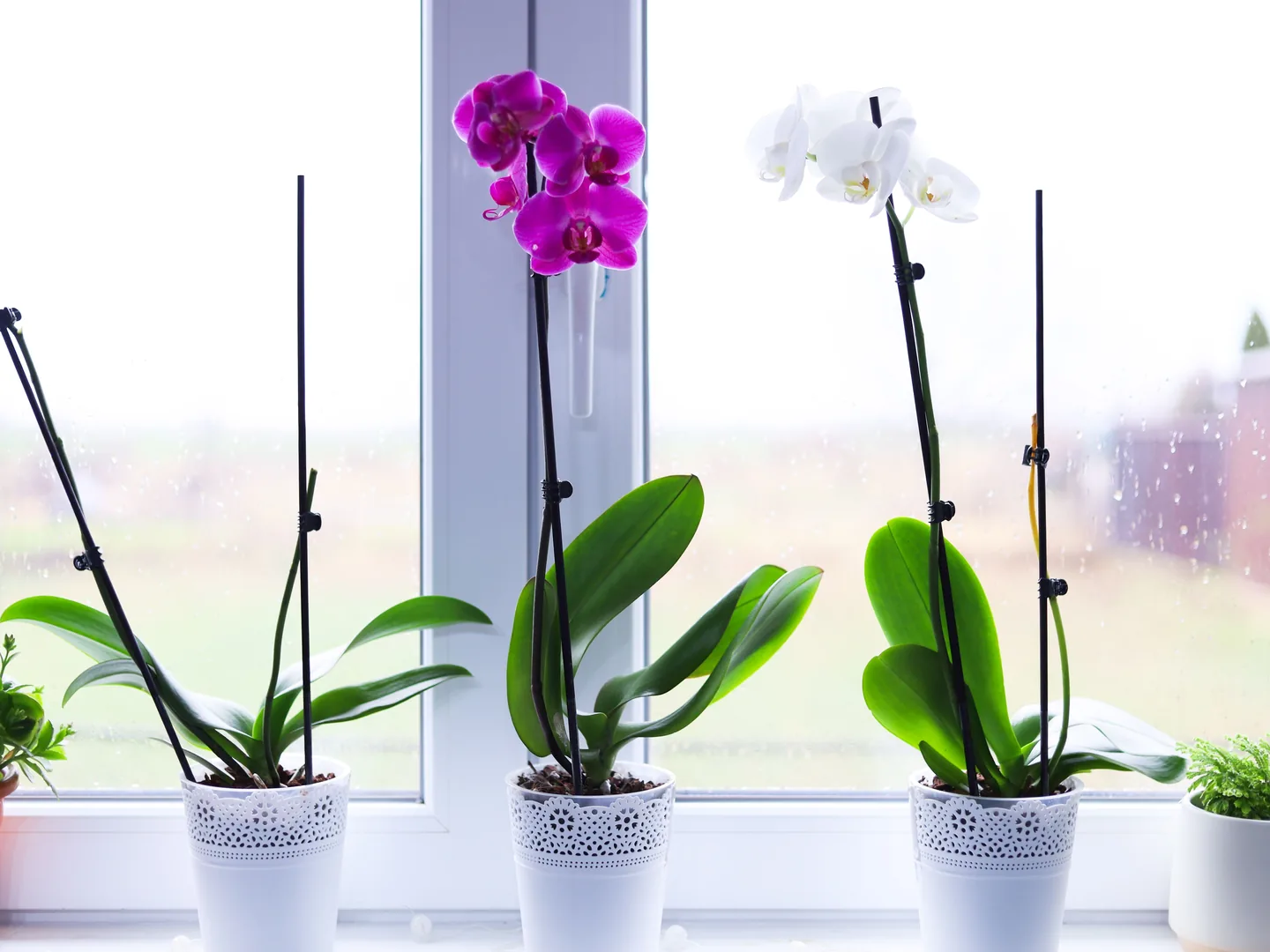
Photo: Ionel Stanciu, Pexels License, via Pexels (cropped and resized)
Light
Moth orchids need bright, indirect light. The New York Botanical Garden, the American Orchid Society and Clemson Extension name an east-facing window as ideal or preferred; in a south- or west-facing window, the New York Botanical Garden and the American Orchid Society suggest a sheer curtain or moving the plant back from the glass. Sources differ on other windows: Iowa State University Extension lists east and north windows as ideal for moth orchids, while the Chicago Botanic Garden advises against north windows for orchids because they don’t provide much light, and against west windows because they can get too warm in the afternoon. University of Maryland Extension notes that in the short days of winter, a moth orchid can even take direct light in a south window.
The leaves show whether the light is right. The American Orchid Society and Missouri Botanical Garden describe olive-green leaves as a sign of the right amount of light, dark green leaves as too little light, and red-tinged leaves as too much; University of Maryland Extension describes the right color as light green. Too little light is the most common reason moth orchids don’t rebloom (University of Maryland Extension). Too much is risky too: Missouri Botanical Garden notes that sunburn can happen very quickly in strong, direct sun, and for orchids in general, Iowa State University Extension advises moving plants to brighter light gradually. A quick check from the U.S. Botanic Garden: on a bright summer day, hold your hand about six inches above the plant; a faint shadow means enough light for low-light orchids such as moth orchids.
Watering
Moth orchids have no water-storage organs other than their leaves, so the American Orchid Society and Missouri Botanical Garden advise never letting them dry out completely. Water thoroughly, then wait until the mix is nearly dry before watering again (American Orchid Society; Clemson Extension; New York Botanical Garden). Sources word this differently: Iowa State University Extension describes a bark mix kept evenly moist and allowed to dry slightly between waterings, while University of Maryland Extension, in an answer about a moth orchid, suggests letting the mix get mostly dry, because the plant doesn’t want to stay constantly damp.
Check before you water instead of watering by the calendar. The New York Botanical Garden suggests testing with a finger about an inch down, the American Orchid Society and Clemson Extension suggest learning the weight of the pot (a heavy pot doesn’t need water), and for orchids in general, Iowa State University Extension suggests touching the mix or using a wooden chopstick, which comes out dry when it’s time. As a rough guide for a mature plant in bark, Missouri Botanical Garden and the American Orchid Society note that a thorough watering once a week is usually enough; Clemson Extension notes that plants need more water in summer and less in winter. Sphagnum moss stays wet longer than bark (New York Botanical Garden; Iowa State University Extension), so the American Orchid Society suggests watering moss-potted plants when the top feels dry.
Water in the morning so the leaves dry before night (Missouri Botanical Garden), with tepid water (New York Botanical Garden). Let the water drain out completely, and never leave the plant standing in it: for orchids in general, Iowa State University Extension advises emptying saucers, trays and outer pots within 30 minutes. If water collects in the crown, where the leaves join in the center, blot it with a paper towel to avoid crown rot (American Orchid Society; Missouri Botanical Garden). Avoid salt-softened water (American Orchid Society; Missouri Botanical Garden); the New York Botanical Garden notes that moth orchids are less sensitive to tap water than many orchids. University of Maryland Extension notes that silvery or white aerial roots turn pale green once they have had enough water.
What about ice cubes?
Most sources advise against them. The New York Botanical Garden warns that the cold stresses the plant, and Missouri Botanical Garden that cold can cause root death and that a few ice cubes don’t provide enough moisture. One peer-reviewed study (HortScience, 2017) found that three ice cubes a week didn’t shorten the display life of moth orchids potted in bark, but it tested only plants potted in bark; in a preliminary test, ice touching the leaves caused water-soaked spots; and the authors note that the mix still needs checking. The study plants came from a grower that markets ice-cube watering (the authors’ Ohio State University summary). Iowa State University Extension sums it up: most experts advise against ice cubes, though one study found no harm. Room-temperature water, given when the mix is nearly dry, avoids the question.
Potting mix and repotting
Moth orchids grow in a coarse, airy mix, not soil. The New York Botanical Garden and Missouri Botanical Garden recommend a medium-grade orchid bark mix, and Missouri Botanical Garden warns that standard potting mix leads to root rot and plant death. Many moth orchids are sold in sphagnum moss, which stays wetter than bark (Iowa State University Extension). Sources differ on what to do about it: NC State Extension suggests repotting moss-grown plants into bark, while University of Maryland Extension, in an answer about a moth orchid, notes that either works if you adjust your watering. Use a pot with drainage holes (Missouri Botanical Garden).
Repot when the mix breaks down or the plant outgrows its pot. Sources give different intervals: every one to two years (University of Maryland Extension), about every two years (Missouri Botanical Garden) or every two to three years (New York Botanical Garden). Missouri Botanical Garden notes that the mix needs replacing when bark particles wash out during watering or the bark at the drainage hole is no longer firm, and the New York Botanical Garden that broken-down bark turns darker and spongier and may smell musty. Many sources suggest repotting just after flowering: in spring or summer (Missouri Botanical Garden) or in spring (American Orchid Society), while University of Maryland Extension suggests waiting until new growth starts. Sources differ on repotting a plant in bloom: the New York Botanical Garden advises against repotting in bud or flower, because the stress can make buds drop, and Clemson Extension warns that it can damage or kill the plant, while University of Maryland Extension, in an answer about a moth orchid, notes that it can be done, though the flower spike is easier to break, and the American Orchid Society that repotting can be done any time if the roots are kept as intact as possible.
When you repot, remove dead roots with a sterilized blade or pruner. Missouri Botanical Garden describes live moth orchid roots as whitish, firm and plump and dead ones as brown, wiry and dry. Root color varies, so judge firmness as well: the New York Botanical Garden notes that healthy orchid roots should feel firm when gently squeezed. Pot for the size of the root mass and avoid overpotting (Missouri Botanical Garden), and wait several weeks before fertilizing (New York Botanical Garden).
Aerial roots are normal
Moth orchids send out aerial roots that grow over the edge of the pot. University of Maryland Extension notes that this is perfectly normal and that you shouldn’t cut them off, and in an answer about a moth orchid it notes that they don’t have to be forced back into the pot when you repot. The New York Botanical Garden adds that many roots growing out of the pot can sometimes mean the mix has broken down.
Temperature and humidity
Moth orchids like the same warmth people do. The American Orchid Society suggests nights above 60°F and days of 70 to 80°F or higher, with 95°F as the maximum; Missouri Botanical Garden gives nights in the 60s and days of 70 to 80°F, with limits of 50 and 95°F. Other sources’ ranges vary: the New York Botanical Garden’s moth orchid guide gives 65 to 85°F days and 55 to 60°F nights, and Iowa State University Extension advises avoiding temperatures below 55°F. Keep the leaves off cold window glass in winter (Clemson Extension), and keep the plant away from air-conditioning vents and cold drafts (New York Botanical Garden).
Moth orchids prefer humid air, but sources differ on how much they need: at least 50% and ideally 65% or more (New York Botanical Garden), 50 to 80% (American Orchid Society) or 40 to 60% (Iowa State University Extension). Penn State Extension notes that they usually tolerate the humidity of a home. Sources also disagree on how to add humidity. Missouri Botanical Garden and University of Maryland Extension suggest a tray of pebbles and water, as long as the pot sits above the water. In an answer about a moth orchid, University of Maryland Extension notes that a humidifier or grouping plants works better, that pebble trays aren’t worth the trouble of keeping clean, and that misting the leaves doesn’t raise humidity for long and can increase the risk of infection; the University of Connecticut, by contrast, suggests misting in the morning. The New York Botanical Garden notes that moving air helps prevent disease.
Feeding
Orchids need only weak fertilizer, and sources differ on the schedule. The New York Botanical Garden suggests a balanced fertilizer at a quarter of the label strength every time or every other time you water, all year; the American Orchid Society suggests half strength weekly, with clear water once a month to flush out salts; Missouri Botanical Garden suggests half strength weekly and quarter strength in winter; and University of Maryland Extension suggests feeding every third or fourth watering while the plant is growing and flowering, and skipping winter. The New York Botanical Garden notes that it is better to give too little fertilizer than too much, and Missouri Botanical Garden, for orchids in general, that overfertilizing causes the leaf tips to turn brown. For orchids in general, Iowa State University Extension advises wetting a very dry mix before you fertilize.
Reblooming and the flower spike
Light comes first: University of Maryland Extension names low light as the most common cause of a moth orchid not reblooming. Cooler nights help many moth orchids too: the New York Botanical Garden, the American Orchid Society and Missouri Botanical Garden note that several weeks of night temperatures around 55 to 60°F in fall help start new spikes. NC State Extension adds that this chill (about a week at 55°F, in its description) matters for the large-flowered white hybrids that bloom in spring, while modern dwarf hybrids don’t need it. For orchids in general, Iowa State University Extension notes that plants that haven’t been fed enough won’t flower well. A new spike grows slowly, and buds appear a few months later (New York Botanical Garden). Stake the spike as it grows, and don’t turn the plant while it’s growing, or the spike will twist toward the light (Missouri Botanical Garden).
Sources differ on where to cut the spike after the flowers fade:
- Near the base or at leaf level: Missouri Botanical Garden, Clemson Extension and the American Orchid Society note that the plant should then bloom again within about a year, on a strong new spike; the New York Botanical Garden’s growers recommend cutting back the spike to preserve energy for next year’s flowers.
- Just above the second node (the small ridges on the stem): the New York Botanical Garden, Iowa State University Extension and the American Orchid Society note that a side branch may flower in about 8 to 12 weeks, though Iowa State notes it isn’t guaranteed. The American Orchid Society suggests this cut only for a strong, healthy plant, because a second flowering may stress it, and Missouri Botanical Garden notes that it weakens and stresses the plant.
- Just above the first node below the old flowers: NC State Extension and the University of Connecticut suggest this; NC State Extension notes that the node often, but not always, produces a branch with more flowers.
For novelty moth orchids with star-shaped flowers, the American Orchid Society advises not cutting the spike while it is still green, because they flower repeatedly from the same spike. Use sterilized pruners whichever cut you choose (Chicago Botanic Garden). A moth orchid sometimes grows a small plantlet, called a keiki, on the spike (American Orchid Society); for orchids like these, Missouri Botanical Garden suggests waiting until it has roots before cutting it off and potting it in fine bark.
Common problems
These are short summaries; check the signs before you change anything. Visual signs are clues, not proof of a cause, and the same symptom can have opposite causes.
Drooping, limp or wrinkled leaves
Healthy moth orchid leaves are plump and firm. The New York Botanical Garden notes that an underwatered plant has wrinkled leaves that flop, and that the same symptoms appear if the plant is overwatered or stands in water and its roots can no longer take up water; NC State Extension also notes that shriveled leaves can mean the mix is too dry or the roots are damaged, often rotted by a soggy mix. So check the roots before you water more: the American Orchid Society advises taking a dehydrated-looking plant out of its pot to find out why. Firm roots in dry mix mean it needs water; in an answer about a dehydrated moth orchid, University of Maryland Extension suggests soaking the root mass for the next few waterings. Soft, brown roots in wet mix point to root rot (see Root rot). The New York Botanical Garden also notes that leaves can flop after a long flowering. Wrinkled leaves won’t smooth out again, but new leaves should grow normally (New York Botanical Garden).
Brown or black spots
Several causes can look alike. Sunburn, which the American Orchid Society describes as appearing on the part of the leaf most exposed to sun and starting as a whitish or yellowish scar that turns tan or black, can follow a sudden increase in light. Cold can cause pitting, sunken areas and discoloration (American Orchid Society; New York Botanical Garden). Raised, tan, corky scabs after edema blisters are permanent but don’t harm the plant (New York Botanical Garden). The American Orchid Society calls bacterial brown spot the most common disease of moth orchids: it starts as a small, soft, water-soaked blister that may have a yellowish halo, and Missouri Botanical Garden notes that it can advance rapidly and kill the plant if it reaches the crown, and that splashing water can spread it. Bacterial soft rot moves even faster: the American Orchid Society notes that an unchecked infection can rot a plant completely in two to three days. Fungal leaf spots also occur (Iowa State University Extension, orchids in general), and a virus can’t be confirmed by looks alone; it needs testing (Iowa State University Extension). Spots alone don’t confirm a cause, and not every spot is an infection: sunburn scars and edema scabs are permanent marks, not infections in themselves, though the American Orchid Society notes that a sunburn scar can later be invaded by secondary infections. Spots that are soft, water-soaked or spreading fast need quick action: move the plant away from other plants right away, keep its leaves dry and water only in the morning. Then ask your local Extension office for help with diagnosis.
Yellow leaves
The New York Botanical Garden notes that it is common for the lowest, oldest leaf or two to turn yellow, especially in spring as new leaves replace them, and that the oldest leaves yellowing later in the year may indicate trouble. University of Maryland Extension notes that uniform yellowing and shriveling of newer leaves is a sign of distress; check the roots and the mix. For each cause and its fix, see orchid yellow leaves.
Root rot
The American Orchid Society notes that moth orchid roots rot when they are watered too often or the mix breaks down, and Missouri Botanical Garden, for orchids in general, that the prime cause is likely to be a mix that stays wet too long. The New York Botanical Garden describes black or brown roots as rotting or nearly rotting and suggests removing the rotting roots and repotting in fresh mix. Judge firmness as well as color (see Potting mix and repotting).
Buds dropping before they open
Bud drop usually means conditions changed too much: the New York Botanical Garden names temperature swings, drafts, cold on the trip home from the nursery, and a move to a spot with different light or humidity. Missouri Botanical Garden also names rapid temperature changes and drafts, and, for orchids in general, advises not moving a plant while it is in bud. An older American Orchid Society article lists under- or overwatering, low humidity, direct sun on the buds, and fumes such as ethylene from ripening fruit among other causes.
A dying or declining orchid
No single cause explains a declining moth orchid; check the roots and the mix first, then light and temperature. The American Orchid Society notes that a moth orchid can’t grow new leaves if its growing tip rots, though a plant with enough reserves may sprout a new plantlet from its base, and the New York Botanical Garden notes that a moth orchid that loses its stalk and all its leaves after flowering is unlikely to recover.
Pests
The American Orchid Society names mealybugs, scale and mites as the most common pests of moth orchids, and notes that mealybugs and scale can also feed on the roots. For a few scale insects or mealybugs, it suggests removing them with a cotton swab dipped in rubbing alcohol; UC Statewide IPM advises 70% or weaker alcohol, tested on a small part of the plant one to two days first, and cautions that rubbing alcohol is flammable (houseplants in general). A University of Florida IFAS Extension guide to orchid pests in South Florida notes that insecticidal soaps can damage leaves and flower buds in sunny or hot weather. For orchids in general, Missouri Botanical Garden advises checking that a pesticide’s label allows use on orchids, and notes that thrips leave silvery, rough markings and mites large silvery-white areas.
Other common orchids
The advice above is for moth orchids. Other orchids differ, so check the label for the genus name. A few examples from the sources:
- Slipper orchids (Paphiopedilum): low light, like moth orchids; they have no water-storing pseudobulbs and need a mix that is moist but not soggy (New York Botanical Garden; Missouri Botanical Garden).
- Cattleya: high-light orchids that need about twice the light of moth orchids (Clemson Extension), and should dry out between waterings (Missouri Botanical Garden).
- Oncidium and related hybrids: bright, filtered light; the New York Botanical Garden suggests watering when the mix has dried out slightly and never letting it dry out completely.
- Dendrobium: a very diverse group with no one-size-fits-all care (NC State Extension). For the common phalaenopsis-type dendrobiums, the American Orchid Society suggests lots of light but no direct sun, letting the mix get almost dry, and not cutting off the tall, thin stems, because new flower stems grow from them.
- Cymbidium: the American Orchid Society suggests as much light as possible, but not full sun, from spring to autumn, and a constant supply of moisture, with less water from late summer and the mix kept barely moist in winter. They are cool-growing orchids (New York Botanical Garden); the American Orchid Society suggests keeping them outdoors from spring, once nights stay in the mid-40s °F or above, until a light frost is predicted.
Sources differ on orchids with pseudobulbs (the swollen stems at the base of the leaves): for orchids in general, Iowa State University Extension notes that orchids such as Oncidium and Cattleya should dry out completely between waterings, while those without pseudobulbs, such as moth and slipper orchids, should be watered just as the mix dries. The New York Botanical Garden instead suggests watering Cattleya and Oncidium when the mix has almost dried out, and advises never letting Oncidium hybrids dry out completely.
Are orchids safe for pets and people?
Pets: the ASPCA lists the moth orchid (Phalaenopsis) as non-toxic to dogs, cats and horses. It also lists a few named species of Cattleya, Oncidium and Dendrobium as non-toxic, but not every orchid; its entry named “Lady Slipper” is an impatiens, not a slipper orchid. Non-toxic doesn’t mean a pet can eat it freely: the ASPCA notes that eating any plant material may cause vomiting and stomach upset in dogs and cats. If your pet eats a plant and seems unwell, call your veterinarian.
People: our sources give no orchid-specific guidance for people. For any plant someone has eaten: if the person collapses, has a seizure, has trouble breathing or can’t be awakened, call 911 immediately; for other questions, call Poison Control (in the US) at 1-800-222-1222 (National Capital Poison Center).
Frequently asked questions
How often should I water a moth orchid?
When the mix is nearly dry, not on a fixed schedule. In bark, that is often about once a week for a mature plant (Missouri Botanical Garden; American Orchid Society), more often in summer and less in winter; moss stays wet longer. Check by feel or by the weight of the pot (see Watering).
Should I water my moth orchid with ice cubes?
Most sources advise against it. One study found no harm for moth orchids potted in bark, though in a preliminary test, ice touching the leaves caused water-soaked spots (see What about ice cubes?).
Where should I cut a moth orchid’s flower spike?
Near the base for a strong new spike in about a year, or just above a node for a chance of a quicker side branch, which may stress the plant. See Reblooming and the flower spike.
Why won’t my moth orchid bloom again?
University of Maryland Extension names low light as the most common cause. Several weeks of cooler fall nights help many moth orchids start a new spike (New York Botanical Garden; American Orchid Society).
Should I cut off the roots growing out of the pot?
No. Aerial roots are normal for moth orchids (University of Maryland Extension). Cut off only roots that are dead.
Sources
- New York Botanical Garden, Mertz Library guides: Phalaenopsis (2026); Basic orchid care (2026); Troubleshooting orchids (2026); Orchid potting and dividing (2026); Paphiopedilum (2026); Oncidium intergeneric hybrids (2026).
- Missouri Botanical Garden, Kemper Center fact sheets: Orchids: Phalaenopsis (2020), with its Cattleya and Paphiopedilum sheets and its orchid culture and problems guides.
- American Orchid Society: Phalaenopsis culture sheet; Phalaenopsis for the novice; Where do I cut the spike?; Growing Phalaenopsis: what can go wrong (Orchids magazine, 2025); Bud blast (2003); and its novice sheets for Dendrobium and Cymbidium.
- University of Maryland Extension, Home and Garden Information Center: Care of Phalaenopsis Orchids (Moth Orchids); What causes orchid leaves to turn yellow and shrivel? (2018); answers on Ask Extension about moth orchids, watering and potting (2024) and a dehydrated orchid (2025).
- Iowa State University Extension and Outreach: What is the proper care of a moth orchid? (2025); Growing Orchids Indoors, How to Get Orchids to Rebloom and Diagnosing Issues with Orchids Grown Indoors (2026; orchids in general).
- Clemson Cooperative Extension, Home & Garden Information Center: General Care for Phalaenopsis Orchids (2020); Orchids (HGIC 1560).
- NC State Extension Gardener Plant Toolbox: Phalaenopsis; Dendrobium.
- Penn State Extension: Orchids as Houseplants.
- University of Illinois Extension: Orchids make elegant houseplants (2017).
- University of Connecticut Home and Garden Education Center: Orchid Care and Repotting.
- Chicago Botanic Garden: Orchid care. U.S. Botanic Garden: Orchid care tips.
- South, Thomas, van Iersel, Young and Jones, Ice cube irrigation of potted Phalaenopsis orchids, HortScience 52(9), 2017; the authors’ summary on the Ohio State University greenhouse blog (2018).
- University of Florida IFAS Extension: Orchid Insect and Mite Pests in South Florida (ENY2114, 2024).
- UC Statewide IPM Program: Houseplant Problems (Pest Notes 74172; houseplants in general).
- ASPCA Animal Poison Control: Phalaenopsis Orchid; Toxic and Non-Toxic Plants, with its lists for dogs and cats.
- National Capital Poison Center: First aid guidelines.
