
Plant Problems › Drooping Plant
A wilting houseplant isn’t getting enough water into its stems and leaves: Iowa State Extension notes that wilting is the result of roots not providing adequate moisture, and that it can have two completely opposite causes, under-watering or over-watering. So before you water, feel the potting mix. A few kinds of drooping have other causes, covered below.
Quick answer
Causes to check:
- Dry all the way down: the plant probably needs water. Act soon
- Wet potting mix: overwatering or root rot; more water makes it worse. Act soon
- Moist mix, but the plant stays limp: possible root rot; check the roots. Act soon
- A single hot afternoon, with moist mix: a short wilt that can firm up again by evening. Often normal
- Cold or a draft: drooping or discolored leaves after a chill. Act soon
- Crowded roots or salt buildup: water runs through, or salts damage the roots. Fix this week
- Recent repotting: some wilting while the roots settle in; watch the potting mix. Often normal
- Prayer plant leaves folding at night: a normal daily movement. Often normal
- Long, stretched stems leaning toward the window: may point to too little light. Fix this week
Labels show how quickly to act if a cause is confirmed. They are not a diagnosis; check the signs in each section first.
First, feel the potting mix
Push a finger about two inches into the mix, and lift the pot: University of Maryland Extension notes that a plant with dry potting mix weighs much less than one that still has water in it. In a large pot, it suggests pushing a stick or dowel to the bottom; moist mix sticks to it. Don’t judge by the surface alone: Missouri Botanical Garden notes that a pot watered often with small amounts can be sopping wet at the top and bone dry at the bottom. Then match what you find:
- Dry all the way down: the plant probably needs water; see dry potting mix.
- Wet: don’t water; see wet potting mix.
- Moist, but the plant still droops: see moist mix, still drooping.
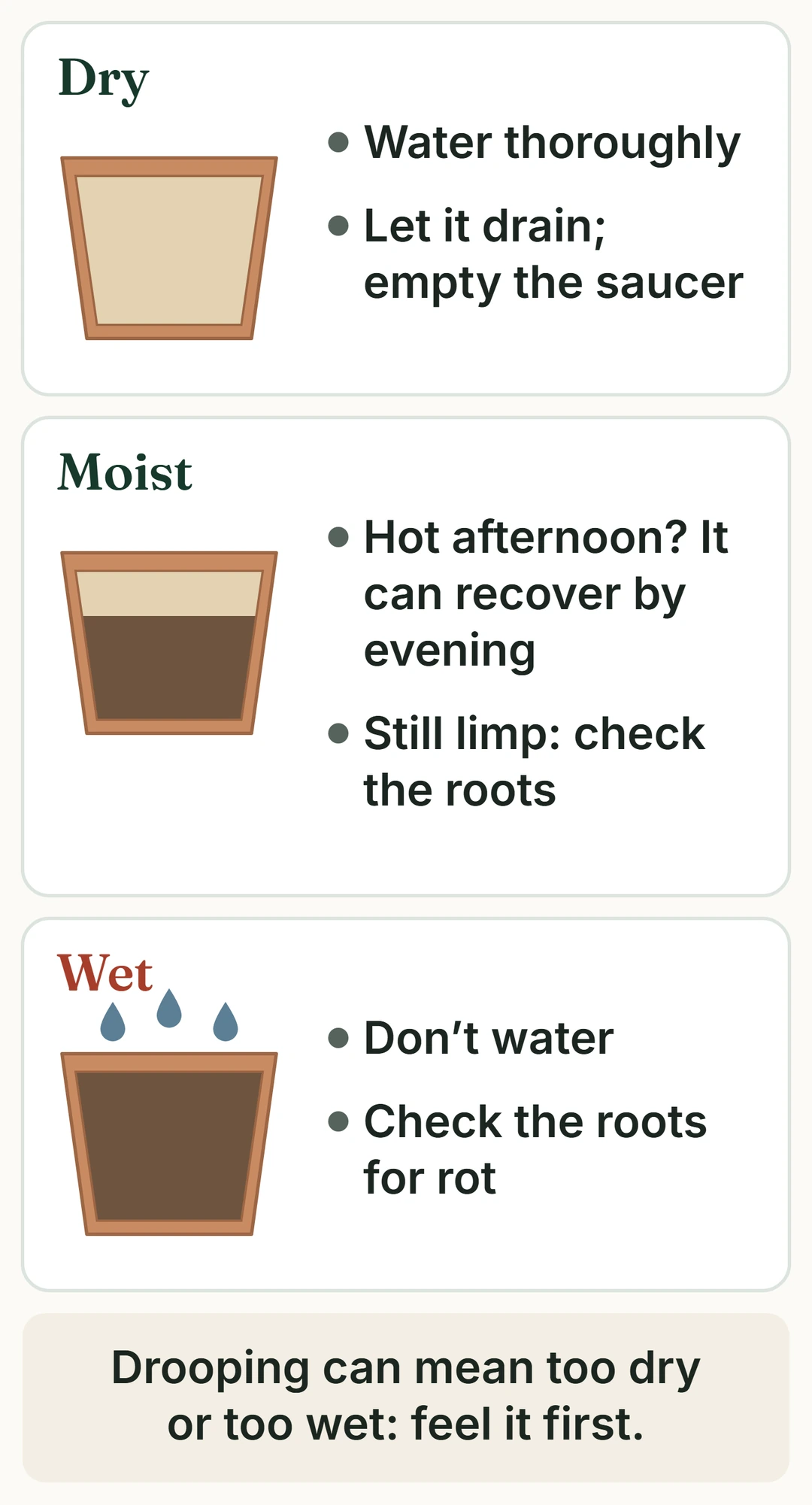
Succulents and cacti need far less water than most houseplants (University of Maryland Extension), so dry mix alone isn’t a reason to water them often.
Dry potting mix
How urgent: Act soon
Clemson Extension notes that chronic under-watering results in wilting, leaf curling and death, so if the mix is dry all the way down, water the plant today.
How to tell
- The plant wilts and turns gray-green (University of Maryland Extension), and the pot feels light.
- The mix has shrunk away from the sides of the pot, and water runs straight out of the drainage hole (Missouri Botanical Garden).
- Some plants show it clearly: Iowa State Extension notes that peace lily leaves wilt when the plant is dry but revive after watering.
What to do
- Water thoroughly until water runs out of the bottom, then empty the saucer (Clemson Extension).
- If the mix has pulled away from the pot, one watering may run straight through. University of Maryland Extension notes that it may need several applications of water; you can also set the pot in a sink or bucket of water and take it out when the surface of the mix is moist (Clemson Extension).
- If the plant stays limp after the mix is moist again, check the roots: Missouri Botanical Garden notes that roots can die from drought, and watering then only makes the dead roots rot.
- To keep it from happening again, find out why the mix dries so fast. Iowa State Extension lists watering too little or not thoroughly, a pot that is too small or made of porous clay, and a pot-bound plant.
Wet potting mix
How urgent: Act soon
Clemson Extension notes that the main cause of death of potted plants is over-watering: roots sitting in water can’t take up oxygen and may rot. Rotting roots can’t move water to the leaves, so the plant wilts even though the mix is wet (University of Maryland Extension).
How to tell
- The mix stays wet, and the plant wilts or yellows, starting with the lower and inner leaves (University of Maryland Extension). Iowa State Extension notes that root rot can begin with wilting of the bottom leaves and that it can be mistaken for lack of water.
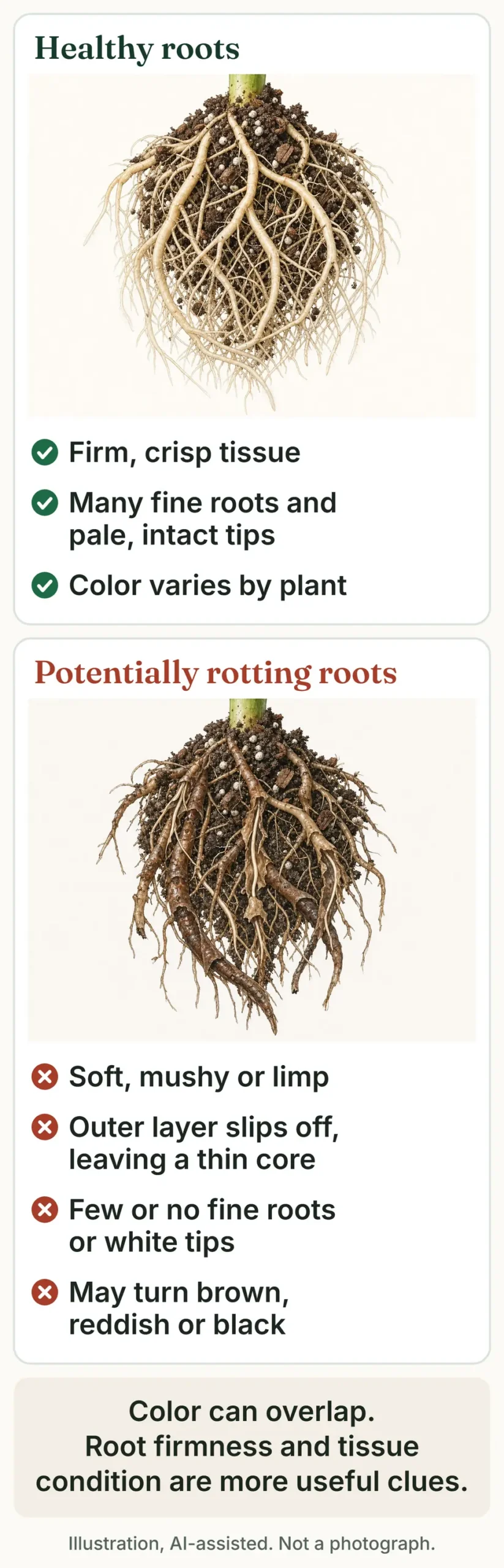
- Roots that are brown to black and soft or mushy, and a stem base that turns black, brown or mushy (University of Maryland Extension). University of Maryland Extension notes that healthy roots should be light-colored and firm; color varies between plants, so firmness tells you more.
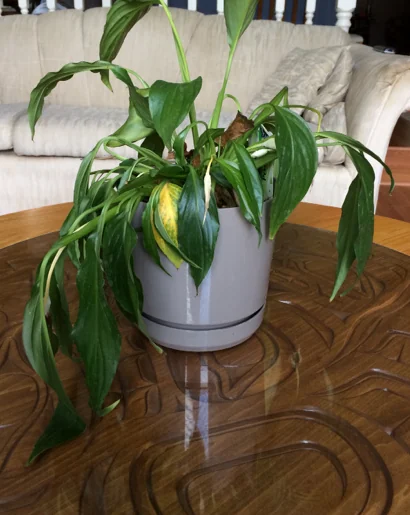
Photo: Scot Nelson, CC0, via Flickr (cropped)
What to do
- Don’t water. Missouri Botanical Garden warns that watering a plant whose roots are rotting is the “death knell” for it.
- Empty any saucer or outer pot that holds water, and find out why the mix stays wet. Iowa State Extension lists watering too often, a pot without a drainage hole, a saucer or sleeve that holds water, old potting mix that has broken down and stays wet, and a pot that is too large.
- Slide the plant out and check the roots. If only a few roots are rotten, Clemson Extension advises cutting them out and repotting in sterile soil. If most are dark, soft and dead, it notes that it is better to discard the plant; Missouri Botanical Garden notes that a plant with root rot may be a candidate for rooting stem cuttings of unaffected shoots.
- Let the mix dry before you water again. Some plants are especially sensitive: Iowa State Extension says the only way to kill a snake plant is to overwater it, and succulents and cacti need far less water than other houseplants (University of Maryland Extension).
Moist mix, still drooping
If the mix is moist but not soggy, the roots can still be the problem, or something around the plant has changed.
- Root rot Act soon: University of Maryland Extension notes that root rot can make plants wilt even when there is adequate moisture in the potting mix. If the plant stays limp, slide it out and check the roots; see wet potting mix.
- A single hot afternoon Often normal: University of Maryland Extension notes that a plant sometimes wilts on a hot day because water evaporates from the leaves faster than the roots can supply it; if there is enough moisture in the mix, it firms up again in the evening, and wilting for short periods doesn’t harm the plant. A plant that wilts again and again needs a root check, and a look at whether its mix dries out too fast (see dry potting mix). University of Maryland Extension also advises keeping houseplants away from heat sources.
- Cold or a draft Act soon: Missouri Botanical Garden notes that dropping, wilting or discolored leaves can be signs of chilling injury, even above freezing, and Iowa State Extension that a big swing in temperature can cause wilting. Move the plant away from the cold window, door or draft. University of Maryland Extension lists protecting plants from temperatures below 50°F as the response to cold injury, and Iowa State Extension advises avoiding temperatures below 55°F.
- Crowded roots Fix this week: in a pot-bound plant, water often passes through too quickly and the center of the root ball stays dry (University of Maryland Extension). Illinois Extension lists a plant that wilts between normal waterings, and Clemson Extension one that wilts shortly after watering, as signs that it needs repotting. Now, check the roots, and if water runs straight through, rewet the root ball by soaking the pot (see dry potting mix). Repot later, once the plant is growing again: Clemson Extension advises repotting into a pot one or two inches wider while the plant is actively growing in spring or summer, not while it is ailing or dormant, and notes that some plants, such as amaryllis, thrive pot-bound. (Iowa State Extension notes that repotting can be done any time of year, although most gardeners have the best success in late winter or early spring.)
- Salt buildup Fix this week: Clemson Extension notes that fertilizer and minerals from hard water accumulate in the soil and cause root damage and wilting, and that white to gray crusty deposits on the soil surface or the rim of the pot are a sign of salt buildup. University of Maryland Extension adds brown leaf tips. If the roots are firm and the pot drains freely, flush the mix with plenty of water (University of Maryland Extension suggests at least twice the pot’s volume in its watering guide and three times in its diagnosis table); it advises repotting if the salt level seems high or the pot drains poorly. For a plant that is wilting, repot once it is growing again (see crowded roots).
- Recent repotting Often normal: Illinois Extension notes that repotting can be stressful and that houseplants may wilt and die back a bit afterward; given enough time, adequate water and the right light, they often establish a good root system and perk back up. Water by feel, not more often: Illinois Extension warns that a pot that is too large can lead to root rot, because the plant can’t use the extra water. If the plant stays limp or the mix stays wet, check the roots (see root rot above).
Drooping that is normal
Prayer plants Often normal: Illinois Extension notes that a prayer plant folds up its leaves in darkness. Leaves that fold up at night on an otherwise healthy plant aren’t wilting; if they stay folded or limp in daylight, go back to the soil check.
A few older leaves falling off Often normal: Iowa State Extension notes that if only a few older, inner leaves are dropping from a plant that otherwise looks very healthy, it is normal shedding as the plant grows. That is about leaves falling off, not going limp: lower leaves that wilt can be an early sign of root rot (Iowa State Extension).
Long, stretched stems that lean toward the light
How urgent: Fix this week
Missouri Botanical Garden notes that plants not receiving enough light often have light green foliage and begin to stretch or lean toward the light, and Iowa State Extension that low light is the typical cause of spindly growth.
What to do
- Move the plant closer to a window or add a grow light (University of Maryland Extension). Change the light gradually: Iowa State Extension advises moving plants to a new light level over several weeks, since a quick move into much brighter light can scorch leaves.
- Iowa State Extension notes that in nearly all cases the new growth looks better once the light is right, but the stretched growth you already have will always look spindly.
When to act quickly
- Drooping with wet potting mix, a plant that stays limp in moist mix, or a soft, dark stem base: stop watering and check the roots today. See wet potting mix.
- Drooping with bone-dry mix: water it now. See dry potting mix.
- Drooping after cold: move the plant away from the cold window, door or draft now. See moist mix, still drooping.
Frequently asked questions
Why is my plant drooping after I watered it?
If the mix is now wet and the plant still droops, the roots may be damaged or rotting: Clemson Extension notes that any injury to the root system reduces a plant’s ability to take up water, and that watering may then make the problem worse. If the mix had shrunk away from the pot, the water may also have run straight through without wetting the root ball (Missouri Botanical Garden). Feel the mix and check the roots.
How long does a wilted plant take to recover?
It depends on the cause. University of Maryland Extension notes that a plant that wilts on a hot day firms up again in the evening if the mix is moist, and Iowa State Extension that peace lily leaves revive after watering. A plant that stays limp after its mix is moist again needs a root check.
Should I mist a drooping plant?
Misting doesn’t fix wilting: Iowa State Extension notes that wilting is the result of roots not providing adequate moisture. University of Maryland Extension also notes that it is questionable whether misting really increases humidity. Feel the potting mix and treat the cause instead.
Not sure what is wrong? Go back to feel the potting mix and start there.
Sources
- University of Maryland Extension, Home & Garden Information Center: Drought Stress to Indoor Plants; Watering Indoor Plants; Overwatered Indoor Plants; Winter Indoor Plant Problems; Root Rots of Indoor Plants; Diagnose Indoor Plant Problems; Pot-Bound Indoor Plants; Low Light Impacts on Indoor Plants; Temperature and Humidity for Indoor Plants.
- Clemson Cooperative Extension, Home & Garden Information Center: Indoor Plants – Watering (HGIC 1459); Houseplant Diseases & Disorders (HGIC 2251); Indoor Plants – Transplanting & Repotting (HGIC 1458).
- Iowa State University Extension and Outreach: Diagnosing Houseplant Problems from Improper Environmental Conditions; How to Care for Houseplants; Root Rots of Houseplants; Easy, Low-Maintenance Houseplants.
- University of Illinois Extension: Repotting; Tips for Repotting Houseplants; Prayer Plant.
- Missouri Botanical Garden: Environmental Problems of Indoor Plants; Problems Common to Many Indoor Plants.
