
Plant Problems › Fiddle Leaf Fig Brown Spots
Brown spots on a fiddle leaf fig (Ficus lyrata) can come from water, light, temperature, pests, sprays or leaf disease. New York Botanical Garden notes that brown leaf spots “can occur for a number of reasons,” and University of Maryland Extension’s horticulturists note that spots from a minor leaf infection and from environmental stress can look alike. Treat what the spots look like, where they are and how the plant has been cared for as clues, not proof.
Spotted areas won’t turn green again: University of Maryland Extension’s horticulturists note that leaves do not heal, so judge a fix by the new leaves. This guide is about Ficus lyrata; the University of California Master Gardeners note that the name “fiddle leaf fig” is also used for a philodendron.
Quick answer
Causes to check:
- Tiny red or brown specks on new leaves: usually a sign the potting mix stays too moist. Fix this week
- Soft, light-colored spots around the veins that turn brown, mix stays wet: too much water or poor drainage. Fix this week If leaves keep dropping while the mix stays wet, check the roots: Act soon
- Crisp, dry brown spots, and the mix is dry well below the surface: too little or irregular watering. Fix this week
- Brown, burned patches where direct sun hits the leaves: sunburn. Fix this week
- Brown spots on shaded lower leaves: too little light. Fix this week
- Spots near a heating or cooling vent, or leaves dropping after a temperature change: drafts and temperature changes. Fix this week
- Spots that spread, look water-soaked or have a yellow edge: possible bacterial or fungal leaf spot. Fix this week Soft, mushy tissue with a rotten smell: Act soon
- Bumps on leaves and stems, white cottony clusters or fine speckling: pests. Act soon
- Spots soon after a spray, leaf shine or home remedy: spray damage. Fix this week
Labels show how quickly to act if a cause is confirmed. They are not a diagnosis; check the signs in each section first.
What’s normal on a fiddle leaf fig Often normal
- Raised white dots that don’t wipe off: New York Botanical Garden explains that these are lithocysts, natural cells most often seen on rubber plants (Ficus elastica) but also possible on fiddle leaf figs, and nothing to worry about. Scale insects also form bumps, often along stems and leaf veins, but they can be picked off with a fingernail (Iowa State Extension; see pests).
- An old lower leaf yellowing and dropping now and then: New York Botanical Garden calls some loss of lower leaves natural, and University of Maryland Extension’s horticulturists note that gradual yellowing and shedding of older, lower leaves is normal as plants mature. If many lower leaves drop at once, look for a problem.
Too much water or poor drainage
How urgent: Fix this week Act sooner if leaves keep dropping while the mix stays wet: Act soon
New York Botanical Garden calls too much water among the most frequent causes of fig failure, and notes that the roots rot easily if overwatered. University of Maryland Extension’s horticulturists add that houseplant figs, fiddle-leaf included, grow best when allowed to get fairly dry between soakings and don’t thrive if kept too wet.
How to tell
- Soft, light-colored spots around the leaf veins that turn brown: New York Botanical Garden links these to too much water in the soil, from overwatering or poor drainage.
- The mix is still damp two inches down days after watering, the pot has no drainage hole, or water stands in the saucer or a decorative outer pot.
- Leaves drop: NC State Extension notes that leaf drop can come from too much or too little water.
- If the mix has been too wet for too long, the roots may rot (University of Maryland Extension). For houseplants in general, University of Maryland Extension notes that healthy roots are light-colored and firm, while diseased roots look dark and soft.
How to fix
- Stop watering until the top two inches of the mix are dry, and empty the saucer. New York Botanical Garden suggests checking about 15 minutes after watering and pouring off any water left in the dish.
- Make sure the pot has a drainage hole. New York Botanical Garden notes that many fig problems start with a decorative container without one; if you use one, lift out the inner pot to water and let it drain completely before putting it back.
- If the mix stays wet even with careful watering, University of Maryland Extension’s horticulturists point to old potting soil, which compresses over time and drains more slowly, and suggest repotting if the plant has been in the same soil for more than a year or two. Spring is a good time, but they note it can be done any time if the plant is suffering.
- If leaves keep dropping while the mix stays wet, ease the plant out of its pot and look at the roots. New York Botanical Garden notes that roots rotted by overwatering may be damaged beyond repair. If you find dark, soft roots, University of Maryland Extension advises cutting out the rotten parts and replanting the healthy sections (houseplants in general).
Prevent it
Water thoroughly, then wait until the top two inches feel dry before watering again (New York Botanical Garden; University of Maryland Extension). In the low light of fall and winter, New York Botanical Garden notes, the plant may take up water more slowly, so check the mix before each watering. It recommends a soil-based potting mix with some added perlite for drainage.
Tiny red or brown specks on new leaves
How urgent: Fix this week
New York Botanical Garden notes that tiny red or brown spots on new leaves usually mean the soil is staying too moist: the spots are ruptured leaf cells, and they don’t harm the plant if you correct the watering quickly. University of Maryland Extension’s horticulturists, answering a question about red spots on a fiddle leaf fig, describe edema as an imbalance between the water in the soil and the water moving out of the leaf, usually because the plant is overwatered.
How to tell
- Many tiny red or brown specks on young leaves.
- The mix stays moist between waterings.
- It isn’t always edema: in one fiddle leaf fig case, University of Maryland Extension’s horticulturists couldn’t be sure edema caused the spots and asked whether the plant had been sprayed, since sprays can also damage leaves.
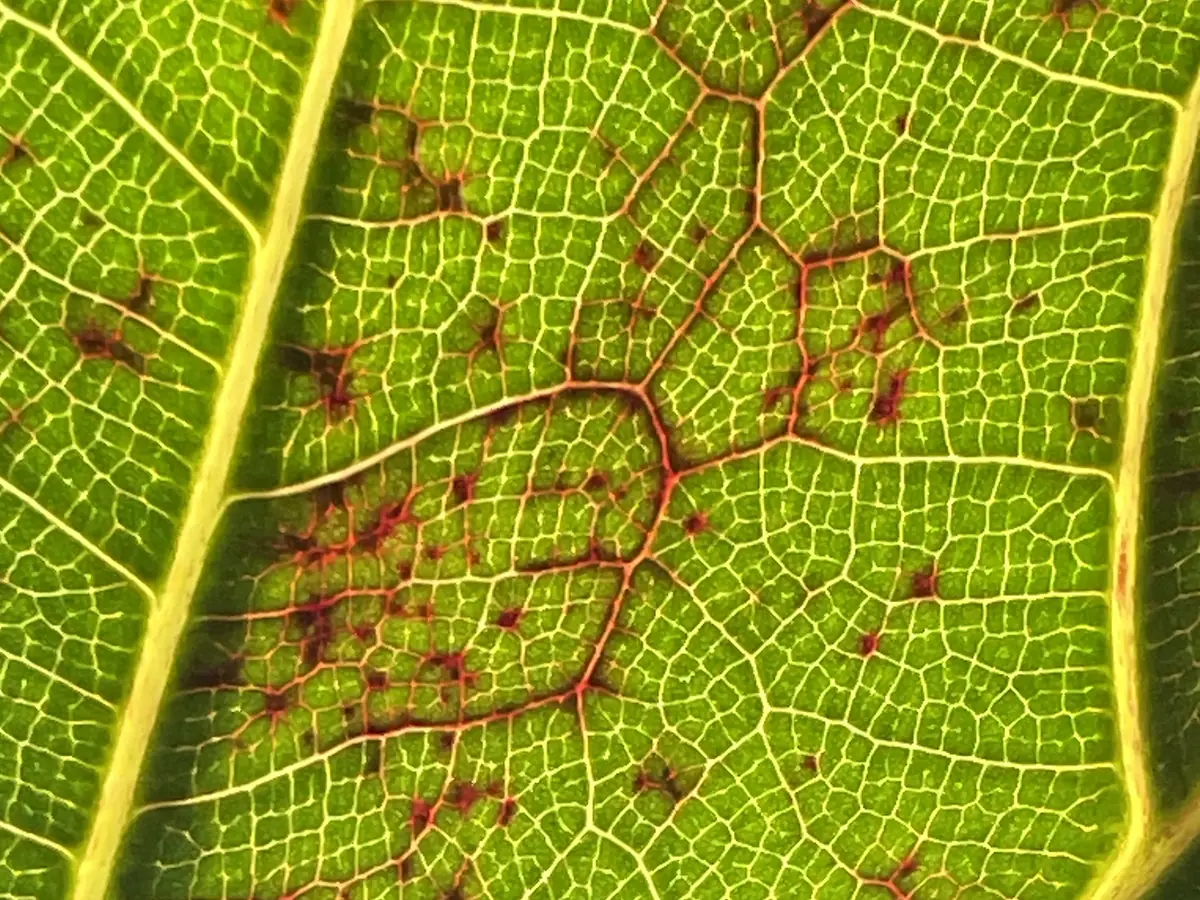
Photo: BezierBaby, CC BY-SA 4.0, via Wikimedia Commons (cropped and resized)
How to fix
- Let the mix dry to about two inches down before watering again, water thoroughly, and empty the saucer (University of Maryland Extension; New York Botanical Garden). For houseplants in general, University of Maryland Extension’s edema guide notes that drying time matters most when the mix is cool and the air is warm.
- Use a pot with a drainage hole and a fast-draining mix (New York Botanical Garden).
- Don’t expect the specks to fade: University of Maryland Extension’s horticulturists note that leaves scarred by edema won’t repair themselves and may drop early.
Crisp brown spots from too little or uneven watering
How urgent: Fix this week
New York Botanical Garden notes that underwatering or irregular watering creates crisp, brown spots on leaves. NC State Extension and the University of California Master Gardeners note that both too much and too little water cause problems; the Master Gardeners name yellow or brown leaves that drop early as the signs.
How to tell
- Crisp, dry brown spots rather than soft ones.
- The mix is dry deep down, or water runs straight through: New York Botanical Garden notes that mix watered incompletely can dry out too far and start to repel water.
How to fix
- If the mix is dry two inches down, water thoroughly until water runs out of the drainage hole, then empty the saucer. If it is still wet, see too much water.
- If the mix repels water, New York Botanical Garden suggests watering from the bottom: set the pot in a tub of tepid water, hold it down until air bubbles stop rising, then let it drain and empty the dish.
- Keep to a steady routine: check the mix and water when the top two inches are dry.
Sunburn or too little light
How urgent: Fix this week
Fiddle leaf figs need bright light, and New York Botanical Garden advises keeping the sun’s direct rays off the leaves: it suggests the brightest room in your home, just far enough from the window that the sun’s direct rays don’t touch the plant, or a sheer curtain in between. NC State Extension notes that leaf scorch can occur in too much direct sun and advises protection from the afternoon sun. Sources differ on morning sun: the University of California Master Gardeners write that fiddle leaf figs love it.
How to tell
- Sunburn: brown, burned spots on leaves the sun reaches. New York Botanical Garden notes that leaves can burn in spots in direct sunlight. For houseplants in general, University of Maryland Extension notes that sun damage starts as pale, bleached or faded areas that turn brown and brittle, and is worse when strong sun meets dry soil.
- Too little light: brown spots on lower leaves that don’t get enough light. Long, drooping branches with leaves spaced far apart are another sign of too little light (New York Botanical Garden).
How to fix
- Move the plant out of direct sun, or filter the light with a sheer curtain.
- If the lower leaves are shaded, raise the plant on a stand or move what blocks the light, and turn it a quarter turn each time you water so all sides get light (New York Botanical Garden).
- If the plant spends the summer outdoors, keep it out of direct sun (New York Botanical Garden), and make big changes in light gradually.
Drafts and temperature swings
How urgent: Fix this week
NC State Extension notes that brown spots may occur when room temperatures fluctuate from heating or cooling vents. New York Botanical Garden calls fiddle leaf figs very sensitive to temperature changes and recommends steady room temperatures of 65 to 75°F with good air circulation; drafts from air-conditioning vents, open windows and doors, and heat vents are all poorly tolerated. University of Maryland Extension’s horticulturists name the path of an HVAC vent as one possible cause of brown spots.
How to tell
- The plant sits near a heating or air-conditioning vent, an outside door or a drafty window.
- Leaves drop after a temperature change, such as a thermostat change while you were away or the trip home from the store (New York Botanical Garden), or brown spots appear where room temperatures swing near a vent (NC State Extension).
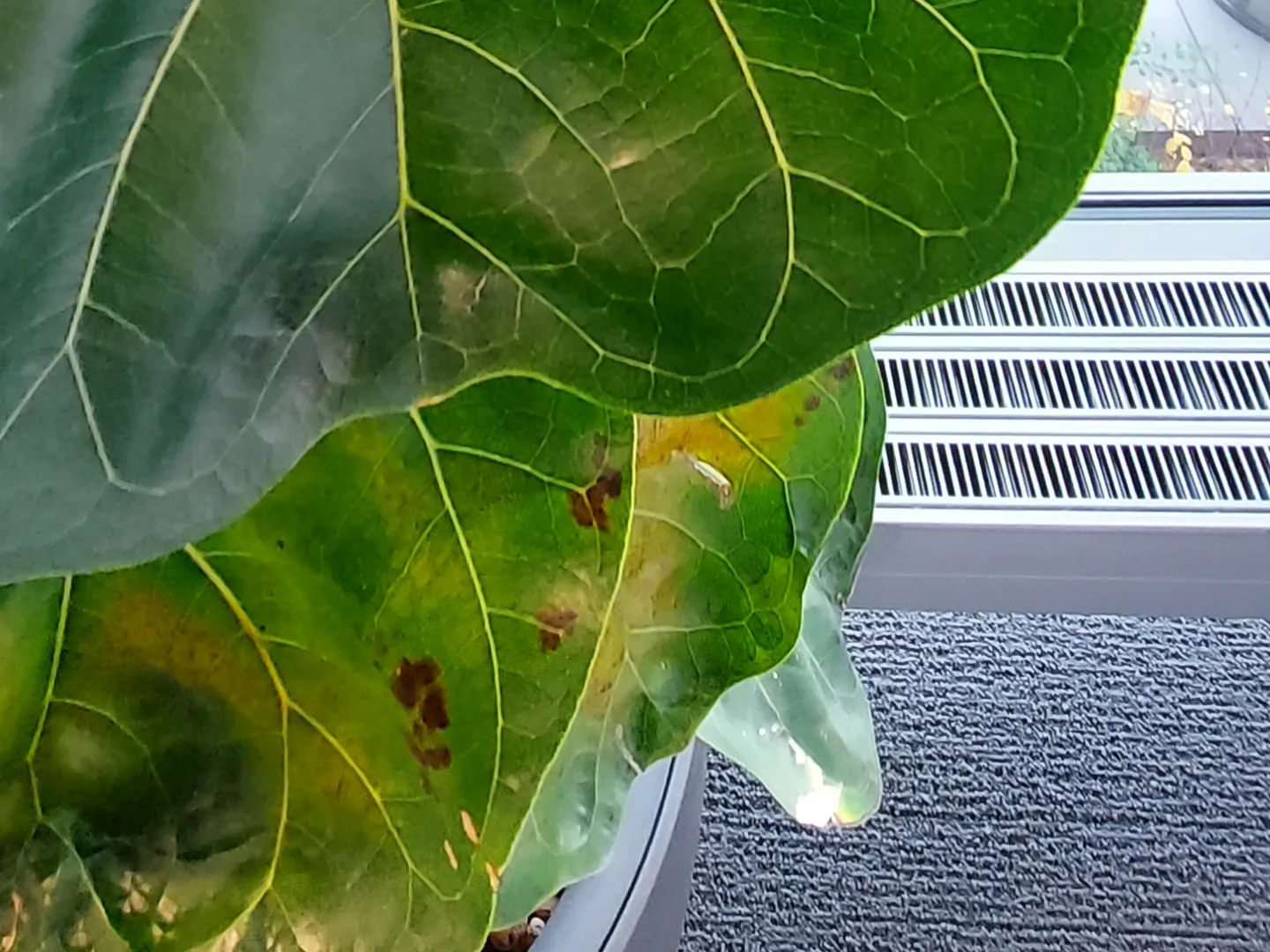
Photo: Mantelmoewe, CC0, via Wikimedia Commons (cropped and resized)
How to fix
- Move the plant out of the path of vents and drafts.
- Keep the room steady, between 65 and 75°F. New York Botanical Garden suggests lowering it slightly in winter, to around 65°F, and gradually. NC State Extension notes that the plant performs best above 55°F.
Bacterial or fungal leaf spot
How urgent: Fix this week Act sooner if tissue turns soft and mushy with a rotten smell: Act soon
Bacterial and fungal diseases can cause leaf spots, but New York Botanical Garden notes that they often appear on a plant already stressed by something in its growing conditions or care. University of Maryland Extension’s horticulturists add that spots from a minor infection and from environmental stress can look alike.
How to tell
- Bacterial spots: for houseplants in general, University of Maryland Extension describes black to brown, often watery spots, often between the veins and angular, sometimes with yellow margins; collapsed tissue is soft and mushy with a rotten smell.
- Fungal spots: tan to reddish brown to black, roughly circular spots that may run together (University of Maryland Extension, for houseplants in general).
- University of Florida IFAS, writing for commercial growers, describes Pseudomonas leaf spot on fiddle leaf fig as water-soaked, angular spots scattered over the leaves, favored by warm temperatures and high humidity.
How to fix
- Pick off badly spotted leaves (University of Maryland Extension).
- Keep the leaves dry: University of Maryland Extension advises watering early in the day so the leaf surfaces can dry quickly. University of Maryland Extension’s horticulturists advise against misting often, because it can lead to leaf disease; the University of California Master Gardeners do suggest misting and wiping the leaves. UF/IFAS notes, for commercial growers, that bacteria splash easily from plant to plant with overhead watering.
- Fix the conditions: good light, steady temperatures, and watering that is neither too frequent nor too infrequent (University of Maryland Extension).
- Don’t count on a spray. University of Maryland Extension’s horticulturists note that few, if any, fungicides are labeled for use indoors and that they can’t cure existing infections; for one fiddle leaf fig with leaf spots, they recommended no chemical control, only good care. University of Maryland Extension’s fungal leaf spot guide (houseplants in general) notes that registered fungicides labeled for houseplants can be used, but that removing infected leaves and keeping conditions drier should help in most homes.
- If a bacterial infection becomes systemic, spreading inside the plant, University of Maryland Extension notes that there is no cure and advises discarding the plant (houseplants in general). Spots on many leaves alone don’t show this.
Pests
How urgent: Act soon
NC State Extension lists scale, aphids, mealybugs, thrips and spider mites to watch for on fiddle leaf figs grown indoors, and Iowa State Extension advises dealing with scale, mealybugs, spider mites and aphids on houseplants right away, before populations become unmanageable. The University of California Master Gardeners suggest looking for insects each time you water.
How to tell
- Scale: raised bumps on leaves and stems that can be removed; black or brown (University of Maryland Extension), or white, brown, gray or reddish (Missouri Botanical Garden), both for houseplants in general.
- Mealybugs: white cottony insects (University of Maryland Extension). Its horticulturists identified them on one fiddle leaf fig that also had brown spots.
- Spider mites: fine stippling of tiny dots on the leaves, sometimes with webbing (University of Maryland Extension).
- Thrips: silvery streaks; heavily infested leaves look brownish or silvery (Missouri Botanical Garden, for indoor plants in general).
How to fix
- For a light mealybug infestation, University of Maryland Extension’s horticulturists suggest wiping the insects off with a damp paper towel; if they keep coming back, check the roots, since mealybugs can infest them too.
- Wipe the large leaves regularly with a damp cloth: New York Botanical Garden notes that this also helps reduce mites. Support each leaf as you wipe, because young leaves are easily damaged by touch.
- For heavier infestations, University of Maryland Extension (houseplants in general) suggests a spray registered for houseplants, used as its label directs, and cautions that plants already damaged by heavy insect or mite feeding can be injured by insecticidal sprays.
Spray and leaf-shine damage
How urgent: Fix this week
University of Maryland Extension’s horticulturists note that sprays such as pesticides, leaf shine or home remedies can damage leaf tissue (phytotoxicity). New York Botanical Garden advises against polishes and oils on the leaves, which build up and block light. UF/IFAS adds, for commercial growers of ornamental Ficus, that anthracnose, a fungal leaf spot, often follows tissue damage from pesticide misuse.
How to tell
- Spots appeared soon after a spray, leaf shine or home remedy was used on the leaves.
How to fix
- Stop using the product, and clean the leaves only with a damp cloth (New York Botanical Garden).
- If you need a pesticide, choose one registered for houseplants and follow its label (University of Maryland Extension).
Brown edges and tips
Brown leaf edges are a different pattern from spots. New York Botanical Garden notes that they often point to low humidity and that keeping it above 40% prevents brown tips. The University of California Master Gardeners also link browning leaf margins to low humidity, and burnt margins to overfeeding. University of Maryland Extension’s horticulturists note that brown edges are hard to diagnose and can also come from overwatering, underwatering, temperature changes or moving the plant.
Should you cut off leaves with brown spots?
- Leaves that are badly spotted or dying can go. New York Botanical Garden notes that dead leaves can be removed at any time, and University of Maryland Extension notes that leaves with leaf-spot infections can be picked off.
- For a leaf that is slowly yellowing and dying, University of Maryland Extension’s horticulturists suggest waiting, where possible, until it falls, so the plant can take back what it can from the leaf.
- When pruning, New York Botanical Garden advises leaving at least two-thirds of the leaves on the tree.
- Wear gloves: NC State Extension notes that the milky sap can irritate the skin.
Fiddle leaf fig at a glance: bright light, out of strong direct sun (sources differ on morning sun) · water thoroughly when the top two inches are dry, then empty the saucer · a pot with a drainage hole · steady 65 to 75°F, away from vents and drafts · humidity above 40% · feed only in spring and summer, at half strength (New York Botanical Garden; University of California Master Gardeners) · full fiddle leaf fig care guide
Not sure which cause fits? Start with the potting mix: feel it two inches down, then look at where the spots are and what changed recently (see too much water).
Sources
- New York Botanical Garden, LuEsther T. Mertz Library: Fiddle-leaf fig (Ficus lyrata).
- NC State Extension Gardener Plant Toolbox: Ficus lyrata.
- University of Maryland Extension, Home and Garden Information Center, answers on Ask Extension: Fiddle Leaf Fig (2020); Leaf dropped off on new fiddle tree (2021); Brown Spots and White Substance on Fiddle Leaf Fig Plant (2024); Brown tips on fiddle leaf fig (2025); Holes, Spots, and White Flecks on Fiddle Leaf Fig (2019).
- University of Maryland Extension: Edema on Indoor Plants; Excess Light on Indoor Plants; Bacterial Leaf Spots on Indoor Plants; Fungal Leaf Spots on Indoor Plants; Diagnose Indoor Plant Problems.
- University of California Master Gardeners (UC ANR, The Coastal Gardener): Fiddle Leaf Fig Houseplant – Proper Care (2021).
- University of Florida IFAS Extension: Ornamental Ficus Diseases: Identification and Control in Commercial Greenhouse Operations (PP308; written for commercial growers).
- Iowa State University Extension and Outreach: Diagnosing Houseplant Problems Caused by Insect Pests.
- Missouri Botanical Garden: Problems Common to Many Indoor Plants.


