
Care Basics › Watering
Watering on a fixed schedule instead of by the plant can give it too much or too little water, as University of Maryland Extension notes. This guide shows you how to tell when a houseplant needs water, how to water it thoroughly, and how to adjust for the plant, the pot and the season.
Iowa State Extension calls improper watering the number one reason people have problems with houseplants, and Clemson Extension names overwatering as the main cause of death of potted plants. Roots need both water and oxygen. When they sit in water, they cannot take up oxygen and may rot.
Quick answer
- Check before you water. Water most houseplants when the potting mix feels dry an inch or two down. Cacti and succulents can dry out more; maidenhair ferns, prayer plants and others that like evenly moist soil should not dry out (see your plant’s watering type).
- Water thoroughly. Pour water onto the soil until it runs out of the drainage hole.
- Empty the saucer. Never leave the pot standing in water.
- Adjust, don’t schedule. Light, warmth, the pot, the potting mix and the season all change how fast a plant dries out. Houseplants generally need less frequent watering in winter.
When to water: check the soil, not the calendar
University of Maryland Extension advises against watering on a schedule, because it can give plants too much or too little water. Iowa State Extension suggests checking for water on a regular schedule instead, and watering each plant only when it needs it.
Four ways to tell
- Feel the soil. Push a finger into the potting mix. Iowa State Extension says to water when the soil is dry to the touch down an inch or so; University of Maryland Extension suggests testing to about two inches. If the surface still feels wet, wait, as Missouri Botanical Garden advises for most plants.
- Lift the pot. A pot with dry mix weighs much less than one that still holds water, University of Maryland Extension notes. Missouri Botanical Garden adds that a pot that feels a little light is about right for most houseplants.
- Tap a clay pot. Clemson Extension notes that drying mix shrinks away from the sides of a clay pot. Rap the pot: a hollow sound means it needs water, and a dull sound means the mix is still moist.
- Look at the mix. Potting mix turns lighter in color as it dries, according to Clemson Extension.
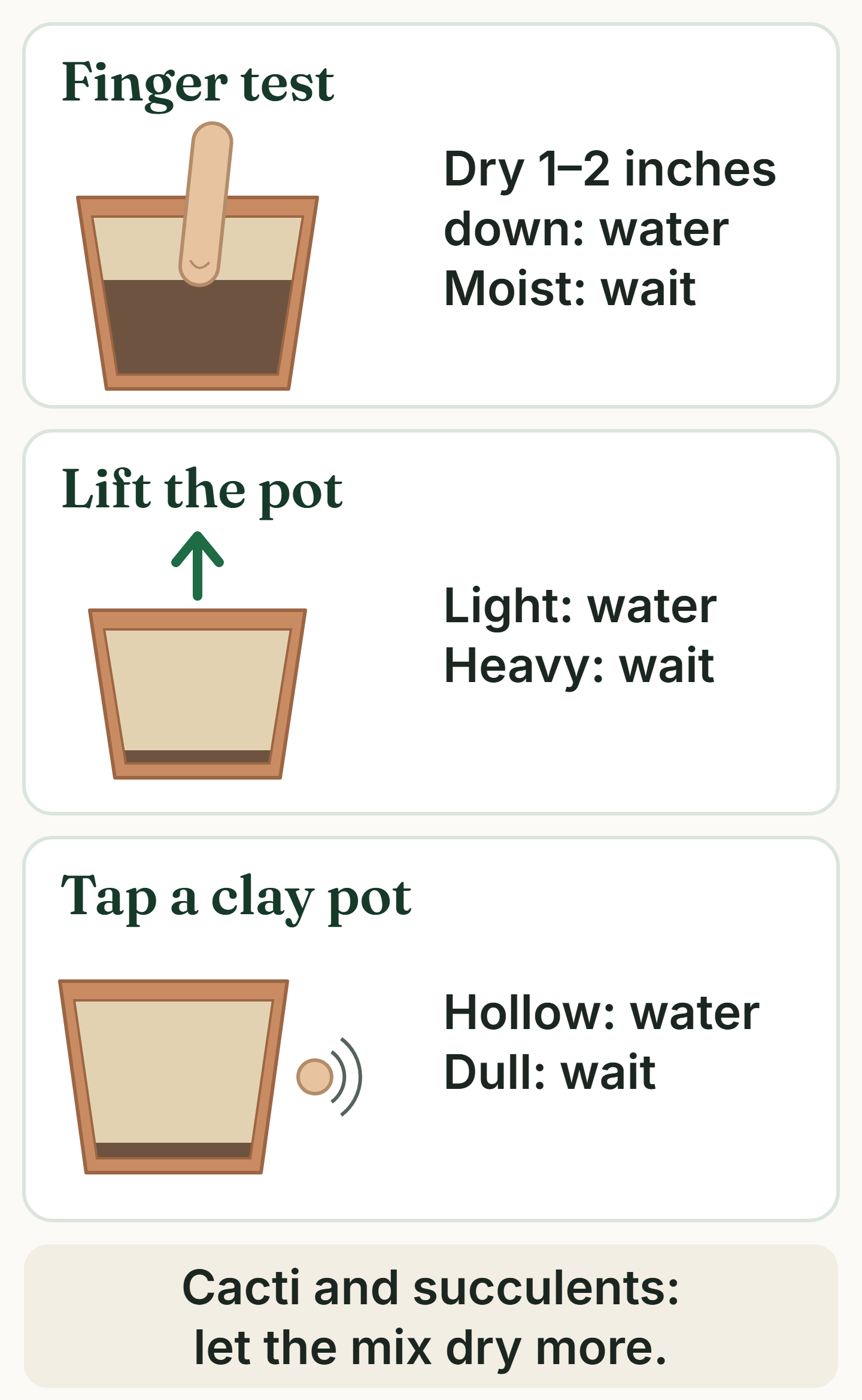
Moisture meters can help with large pots that are hard to lift, but Clemson Extension notes that they vary widely in accuracy, and that fertilizer and soil type can affect the reading. Because the top of the pot dries first, Missouri Botanical Garden suggests taking a reading about a quarter of the way down and another about halfway down.
Wilting is not a sure sign of thirst. Any root damage, including root rot from too much water, can make a plant wilt, and Clemson Extension warns that watering it then may make the problem worse. Check the soil first; if it is still wet, check the roots (see signs you’re watering wrong).
How to water a houseplant
- Pour water onto the soil surface. Wisconsin Extension says a narrow-spouted watering can is easiest for most plants.
- Keep going until water runs out of the drainage hole. Clemson Extension explains that this washes out excess salts and makes sure the lower two-thirds of the pot, where most of the roots are, gets enough water.
- Let the pot drain, then empty the saucer or decorative outer pot. Wisconsin Extension suggests letting the pot drain for 10 to 20 minutes before removing the excess; Iowa State Extension says to remove it after about 30 to 45 minutes. Either way, never leave the plant standing in water: Iowa State notes that roots that stay in water for long periods will rot.
- Wait until the mix has dried to the right level for that plant before you water again (see watering types).
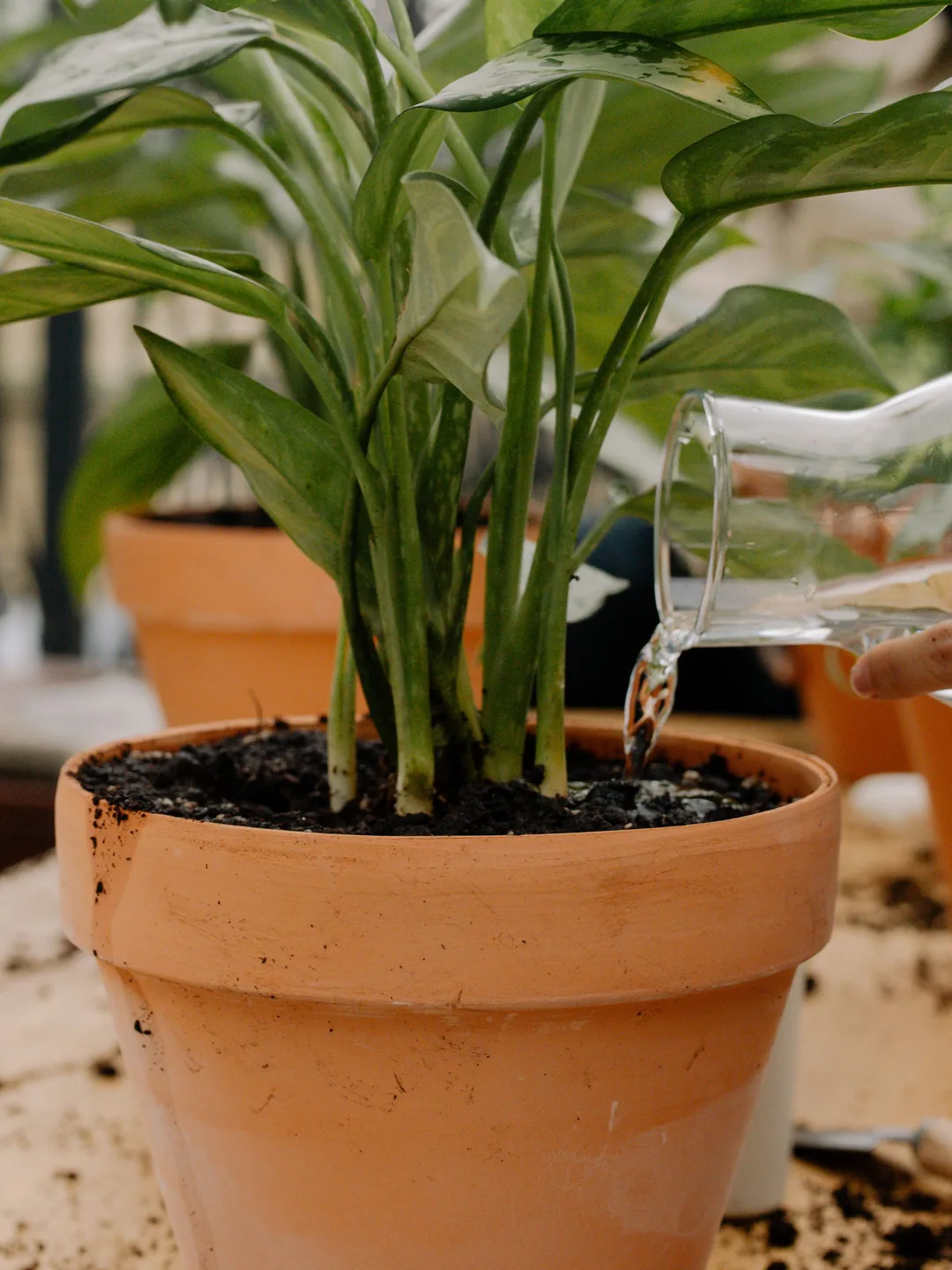
Photo: cottonbro studio, Pexels License, via Pexels (cropped and resized)
Small plants can be watered in a sink, left to drain and then put back, as University of Maryland Extension suggests. Water well and less often: Missouri Botanical Garden notes that you will generally have fewer root problems if you avoid watering frequently with small amounts.
Water temperature and water type
Use water at room temperature. Clemson Extension advises against hot or cold water and gives a range of 62 to 72°F. Avoid softened water: University of Maryland Extension, Clemson Extension and Missouri Botanical Garden all advise against it, and Clemson notes that it adds sodium and chloride to the potting mix. Iowa State Extension notes that if tap water is safe to drink, it can be used on most indoor plants. Wisconsin and Illinois Extension suggest letting tap water sit for at least 24 hours; Missouri Botanical Garden treats this as optional. University of Maryland Extension and Missouri Botanical Garden note that a day’s standing lets chlorine evaporate. Missouri Botanical Garden adds that chlorine does not harm most plants, though some may develop brown leaf tips over long use; Wisconsin Extension says chlorine and fluoride can cause tip burn on many houseplants. Wisconsin and Illinois say fluoride dissipates too, but Missouri Botanical Garden notes that fluoride cannot be removed by letting water sit, and that it harms only a few sensitive plants, such as spider plants and dracaenas; if brown tips or spots become a problem, it suggests rainwater, and notes that distilled or dehumidifier water can also be used. Iowa State Extension cautions that dehumidifier water used extensively over a long time can build up metals in the mix.
If the mix is bone dry
Very dry potting mix can be hard to rewet, and water may run straight through. Clemson Extension suggests watering a second time about half an hour later, or setting the pot in a sink or bucket of water until the surface is moist and then letting it drain completely. Iowa State Extension suggests soaking the root ball for about 30 minutes.
How often to water houseplants
There is no single answer. Clemson Extension notes that how much and how often a plant needs water depends on the species, its growth stage, its location, the type and size of its pot, the potting mix and the weather. These are the main differences:
- Light and warmth: a plant in a warm, dry, sunny spot needs water more often than one in a cool, low-light spot (Clemson Extension).
- Pot material: unglazed clay pots dry out faster than plastic or glazed pots, so plants in them need water more often (Clemson, Illinois and Iowa State Extension).
- Pot size: a large plant in a small pot needs water more often than a small plant in a large pot (Clemson Extension).
- Potting mix: dense mixes and mixes with a lot of peat moss hold more water than loose mixes with bark, sand and perlite (Clemson Extension).
- Growth and season: a plant needs more water when it is actively growing than during slow growth, such as winter (Wisconsin Extension). Clemson Extension adds that plants may slow down after a flush of new growth or heavy flowering, and need less water then and while dormant.
In winter, Iowa State Extension notes that houseplants generally need less frequent watering than in spring and summer. Keep checking the soil rather than switching to a new fixed schedule.
Know your plant’s watering type
Missouri Botanical Garden sorts indoor plants into five watering groups. Look up your plant to see which one fits:
- Evenly moist soil that doesn’t dry out: maidenhair fern, fittonia, prayer plant and poinsettia.
- Top inch dries out, then a thorough watering: most houseplants, including dumb cane, pothos and syngonium.
- Soil dries out between waterings: cacti and succulents, which Missouri Botanical Garden lists with jade plant, aloe, kalanchoe, sedum and hoya.
- Grows in standing water: umbrella plant (Cyperus), sedges, rushes and water plants. These are the exception to the no-standing-water rule.
- Water into the leaf rosette: many vase-shaped bromeliads, which hold water in a central cup. Missouri Botanical Garden suggests refreshing it now and then by overfilling the cup.
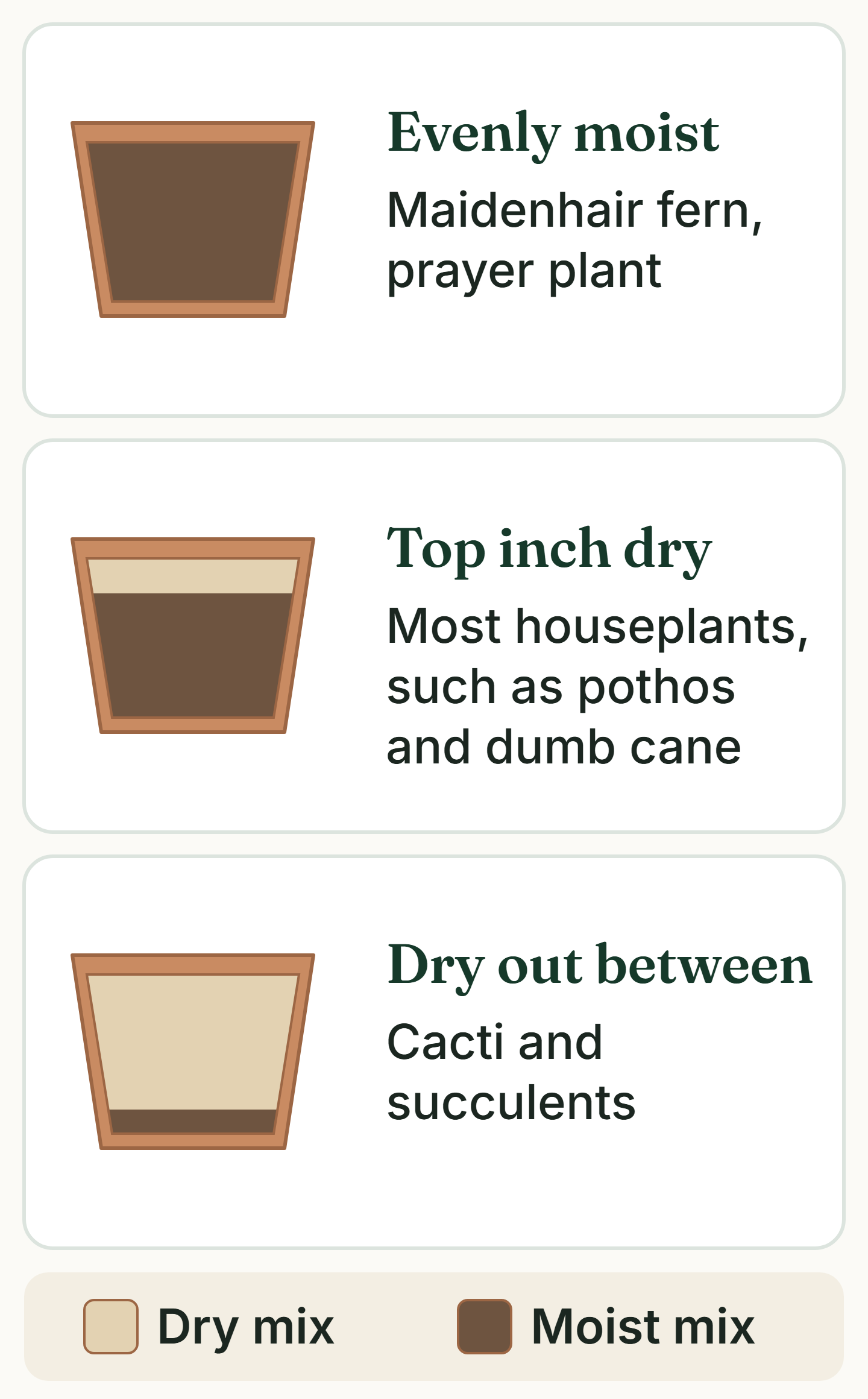
Many plants may also go through a rest period, usually in fall or winter, when they want less water, according to Missouri Botanical Garden. Clemson Extension notes that plants with large or very thin leaves, or fine surface roots, usually need water more often than succulents with fleshy leaves and stems that store water.
Pots and drainage
The most important point, Missouri Botanical Garden says, is that the pot has a drainage hole so excess water can drain into the saucer. Iowa State Extension goes further: every container must have a drainage hole, because without one the soil stays wet.
Decorative outer pots, foil wraps and pot covers can hold water. Missouri Botanical Garden suggests poking holes in foil or cutting off its bottom so excess water can drain. Iowa State Extension describes a double pot (cachepot) as one way to use a container without a drainage hole: keep the plant in an inner pot that drains, and empty the outer pot after watering.
Choose a pot that fits the root ball. Missouri Botanical Garden suggests a new pot generally only about 2 inches larger than the root ball, for example moving from a 6-inch to an 8-inch pot. A pot that is too large holds a mass of soil that roots have not reached yet; it does not dry out enough between waterings and can lead to root rot.
Bottom watering
Missouri Botanical Garden says bottom watering is appropriate for plants that can be damaged by water on their leaves, such as African violets. Set the pot in a tray or a few inches of water, let the mix draw it up until the surface is moist, then take the pot out and let it drain (Missouri Botanical Garden, Illinois Extension). Wisconsin Extension suggests letting African violets stand 20 to 30 minutes before removing the excess water.
Every 3 to 4 months, water bottom-watered plants from the top to flush out salts and minerals that build up from hard water or fertilizer, as Missouri Botanical Garden advises.
Flush out fertilizer salts
Fertilizer and the minerals in water leave salts behind in the potting mix as it dries. University of Maryland Extension lists the signs of salt buildup: reduced growth, brown leaf tips, dropping lower leaves, dead root tips and wilting, sometimes with a crust of salt at the soil line, around the drainage hole or on the outside of clay pots. To flush the salts out, it suggests:
- Scrape off any salt crust on the surface first.
- Pour at least twice the pot’s volume of water through the mix and let it drain completely.
- Do this every four to six months, and before you fertilize, so you don’t wash away fresh fertilizer.
- Repot the plant if salts seem high or the pot drains poorly.
University of Maryland Extension also suggests flushing every newly purchased plant the first time you water it.
Best time of day to water
For outdoor gardens, Penn State Extension recommends watering in the early morning to reduce evaporation and the potential for disease. The houseplant guides cited here don’t name a best time of day for indoor plants. They agree on the more important point: water when the soil shows the plant needs it, not at a set hour or on a set day.
Signs you’re watering wrong
Too much and too little water can look alike. In both cases, Missouri Botanical Garden notes, leaves may turn yellow and wilt.
- Too dry: the plant wilts and turns gray-green (University of Maryland Extension), the pot feels light, and the mix may pull away from the sides of a clay pot (Clemson Extension).
- Too wet: leaves drop or turn yellow (University of Maryland Extension) and the mix stays damp. Wisconsin Extension notes that excess water suffocates roots and can contribute to root rot, resulting in yellowing and eventually wilting.
- Salt buildup: brown leaf tips and a crust of salt deposits; see flushing out salts.
If you suspect too much water, check the roots. Missouri Botanical Garden suggests tipping the plant out of its pot to see whether the soil is very dry or very wet, and whether the roots are rotting.
Frequently asked questions
Should I water my houseplants once a week?
No fixed interval suits every plant. Iowa State Extension notes that watering on a regular schedule, such as every Saturday morning, almost always gives some plants too much water and others too little. Check the soil on a regular schedule instead, and water each plant when it needs it.
Is tap water safe for houseplants?
Usually, for most plants. Iowa State Extension notes that if your water is safe to drink, it can be used on most indoor plants. Use it at room temperature and avoid softened water. Letting it stand removes chlorine but, according to Missouri Botanical Garden, not fluoride; see water temperature and water type.
Why does water run straight through the pot?
When the mix gets too dry, water can run off, around and out the bottom instead of soaking in, Iowa State Extension notes. Water it twice, about half an hour apart, or soak the pot, as described under how to water. Separately, if the mix dries out faster than usual after watering, Wisconsin Extension notes that the plant may need repotting.
My plant is wilting. Should I water it?
Check the soil first. If it is dry, water thoroughly. If it is wet, don’t add more, and check the roots: Clemson Extension warns that root damage, including root rot from too much water, can make a plant wilt, and that watering may make it worse, and Missouri Botanical Garden suggests tipping the plant out of its pot to see whether the roots are rotting. University of Maryland Extension notes that some plants, such as peace lily, wilt when they need water, but that plants can also wilt when overwatered.
Not sure if it’s time to water? Go back to the soil checks and test the mix before you reach for the watering can.
Sources
- University of Maryland Extension: Watering Indoor Plants.
- Clemson Cooperative Extension, Home & Garden Information Center: Indoor Plants – Watering (HGIC 1459).
- Iowa State University Extension and Outreach: How to Care for Houseplants; How often should houseplants be watered during the winter months?
- University of Illinois Extension: Houseplants: Watering.
- University of Wisconsin–Madison Extension: Houseplant Care.
- Missouri Botanical Garden: How to Water Indoor Plants.
- Penn State Extension: Garden Myths: Watering (outdoor gardens; used only for the time-of-day advice).
