
Plant Care Guides › Monstera Care
Monstera (Monstera deliciosa), also called Swiss cheese plant, is a climbing tropical plant grown for its large, glossy, split leaves. Penn State Extension notes that indoors it reaches 6 to 8 feet and needs something sturdy to climb, and Wisconsin Extension notes that it is fairly tolerant of a wide range of conditions once acclimated. This guide covers light, water, soil, humidity, feeding, support and propagation, with a short guide to common problems. Where care guides disagree, we show both views.
Monstera care at a glance
- Light: bright light near a window, without strong direct sun (Penn State Extension; Missouri Botanical Garden); sources differ on direct sun, especially in winter
- Water: water thoroughly, then let the top of the mix dry before watering again (1 to 2 inches, per Penn State Extension and University of Minnesota Extension; sources differ); water less in winter
- Soil: a well-draining potting mix rich in organic matter (Penn State Extension; UConn Extension), in a pot with a drainage hole (University of Maryland Extension; University of Minnesota Extension)
- Humidity: prefers humidity above 50% (Penn State Extension), but tolerates a range once acclimated (Wisconsin Extension)
- Temperature: 60 to 85°F, away from cold drafts (Penn State Extension; NC State Extension); the New York Botanical Garden suggests 55 to 65°F in winter
- Feeding: during active growth; sources differ on how often and on winter feeding
- Support: a moss pole, stake or trellis (Penn State Extension)
- Pet safety: toxic to cats and dogs (ASPCA)
- Difficulty: easy to moderate: forgiving once settled, but it grows large and needs support and room
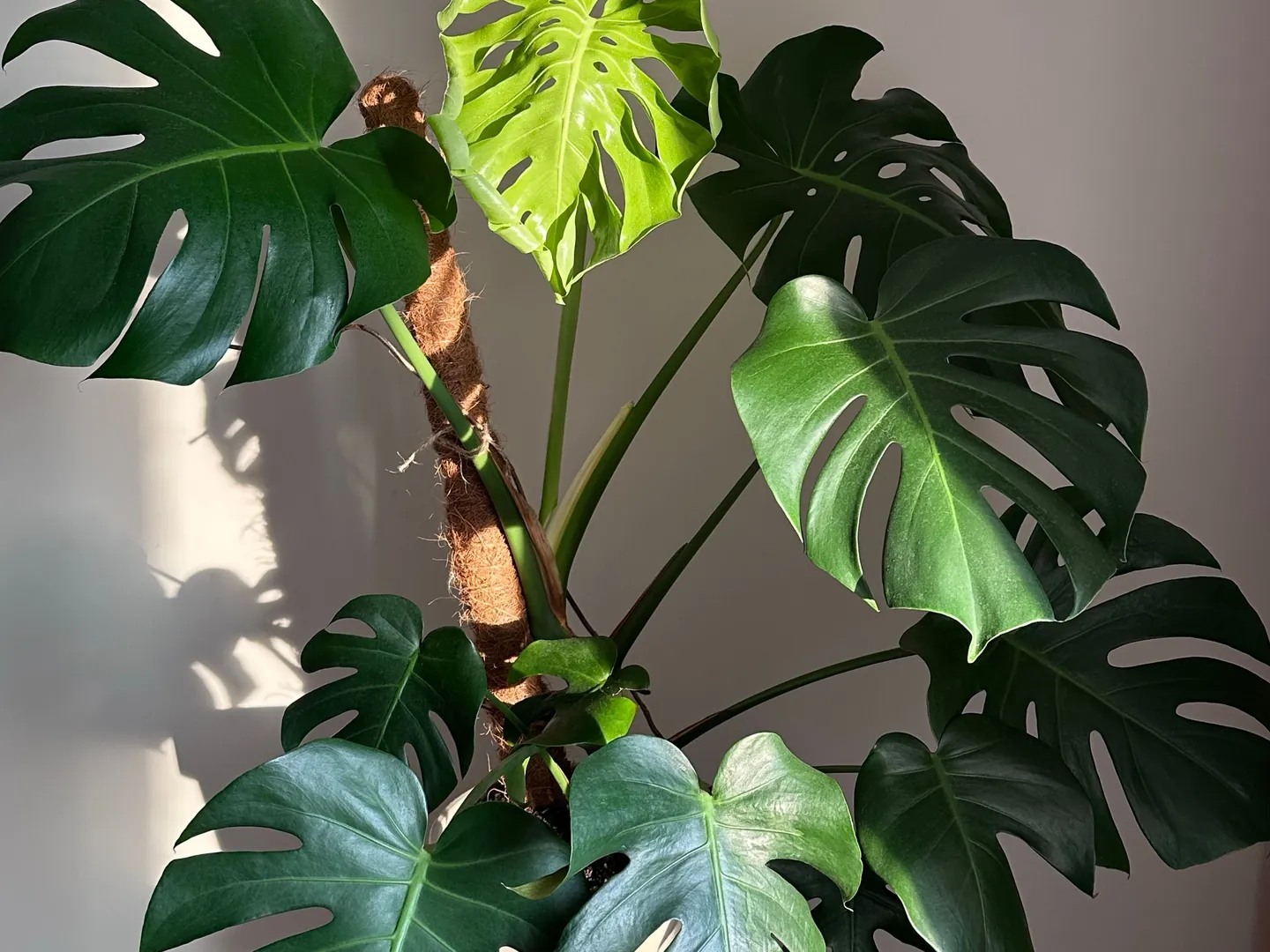
Photo: adri ana, Pexels License, via Pexels (cropped and resized)
Light
Penn State Extension advises a spot near a sunny window where the plant gets bright light but not direct sun, and notes that it gets leggy in lower light. University of Minnesota Extension calls monstera a good houseplant for medium-light locations, and NC State Extension advises moderate brightness but not direct sunlight.
Sources differ on direct sun. Wisconsin Extension notes that monstera does best in bright light in summer and direct sun in winter, and the New York Botanical Garden notes that it needs more direct, bright light in winter. UConn Extension suggests partial shade with 3 to 6 hours of direct sun a day.
Light also shapes the leaves. Wisconsin Extension notes that the leaves won’t develop their perforations when light is inadequate, and NC State Extension notes that variegated cultivars need more sunlight than dark green ones. When you move a monstera into brighter light, do it gradually: UConn Extension warns that its large leaves burn easily.
Watering
Water thoroughly, then let the top of the mix dry before watering again. Penn State Extension and University of Minnesota Extension suggest letting the top 1 to 2 inches dry. Sources differ on how far: NC State Extension suggests the top quarter to one-third of the mix, UConn Extension the top 2 to 3 inches, and the New York Botanical Garden several inches during active growth.
Water less in fall and winter (Wisconsin Extension; Missouri Botanical Garden), and empty the saucer: the New York Botanical Garden advises checking after 15 minutes and removing any water left in the run-off dish.
Overwatering is the more common cause of root problems: UConn Extension notes that drought stress can damage roots, though overwatering is more often the cause of such issues in houseplants, and that monstera is prone to root diseases, especially in colder seasons. Penn State Extension notes that overwatering can result in root rot. If the plant droops while the mix is still wet, check the roots rather than watering again (see drooping).
Soil and repotting
Penn State Extension suggests a well-draining soilless potting mix rich in organic matter, and notes that charcoal, bark or perlite can be added to a purchased mix. UConn Extension also calls for a well-draining mix high in organic matter, and the New York Botanical Garden suggests equal parts potting soil, peat and sand. Use a pot with a drainage hole: University of Maryland Extension’s horticulturists, answering a question about a declining monstera, ask first whether the container drains well.
Sources differ on how often to repot. University of Minnesota Extension suggests repotting every one to two years, in late winter or early spring, into a container about 2 inches wider. UConn Extension advises repotting only when the roots have reached the bottom and sides of the pot, and notes that monstera tolerates being pot-bound much better than being overpotted. The New York Botanical Garden notes that monsteras like to be root-bound and can stay in the same pot for years, while Wisconsin Extension notes that container-grown plants need frequent repotting. Whichever schedule you follow, move up only a little at a time: University of Minnesota Extension suggests a pot about 2 inches wider, and UConn Extension advises increasing pot size incrementally.
Old mix needs attention too, and sources differ here as well. The New York Botanical Garden suggests replacing the top layer of soil every other year once the plant has reached its largest pot. University of Maryland Extension’s horticulturists, answering a question about a declining monstera more than 30 years old, suggested replacing potting mix that has been in the pot for more than a couple of years rather than adding fresh mix on top.
Humidity and temperature
Penn State Extension notes that monstera likes humidity, preferably above 50%, and may benefit from a humidifier if the room is very dry. Wisconsin Extension notes that it prefers medium to high humidity but is fairly tolerant of a wide range of conditions once acclimated. NC State Extension suggests a humidifier or a tray of wet pebbles; keep the bottom of the pot above the water in the tray.
Sources disagree on misting. The New York Botanical Garden suggests misting the plant and its moss pole daily. University of Maryland Extension’s horticulturists advise against misting monstera leaves, because the humidity it adds is minimal and fleeting and wet leaves can encourage disease, and UConn Extension advises avoiding misting to limit the spread of anthracnose. A humidifier avoids the question.
Penn State Extension and NC State Extension give 60 to 85°F as the preferred range, and Penn State notes that monsteras abhor cold drafts. Wisconsin Extension notes that the plant doesn’t grow below 50°F, and the New York Botanical Garden, unlike the 60°F lower limit above, suggests a cooler winter setting of 55 to 65°F. Keep the plant away from blasts of cold or heat from open windows, air conditioners and heating vents (New York Botanical Garden).
Feeding
Feed during active growth, and less or not at all in winter. Sources differ on the details: Penn State Extension suggests a balanced houseplant fertilizer every two weeks in the growing season and monthly in winter; the New York Botanical Garden suggests half-strength fertilizer every two to four weeks from March through September; and Wisconsin Extension suggests feeding regularly from spring until fall. University of Maryland Extension’s horticulturists, answering one owner’s question in November, advised against feeding a monstera over the winter, when growth is limited.
Don’t overdo it: UConn Extension notes that monstera is easily burned by high soil salts, though it tolerates regular feeding during active growth. University of Maryland Extension’s horticulturists add that fertilizer shouldn’t be used on a plant that isn’t healthy.
Support, aerial roots and pruning
Monstera is a climber. Penn State Extension notes that it needs something sturdy to climb, such as a moss stick, trellis, bamboo stake or a board covered with sphagnum moss, and that the plant must be gently attached to the support. NC State Extension notes that sturdy support keeps the stems from breaking, and Missouri Botanical Garden notes that without support the plant tends to grow horizontally. UConn Extension notes that once vines have attached to a support, leaf size typically increases a lot.
Sources differ on aerial roots. The New York Botanical Garden advises not removing healthy aerial roots: guide some into the moss-covered support and leave the rest exposed. Missouri Botanical Garden notes that lower aerial roots can be rooted into the soil, and upper ones attached to a climbing pole or simply removed.
To shape or limit the plant, prune at a node or near a leaf bud. Alison O’Connor, PhD, answering a question on Ask Extension, notes that monstera can be pruned at any time of year, though it may be best to wait until it is actively growing. Wear gloves: Penn State Extension recommends them because handling the plant can cause contact dermatitis, and NC State Extension notes that the sap may irritate skin.
Wipe dust off the leaves (Penn State Extension; Wisconsin Extension). For houseplants in general, University of Minnesota Extension suggests a damp cloth and advises never using leaf shine products or milk.
Propagation
Penn State Extension notes that monstera is propagated most easily by air layering or stem cuttings. Every cutting needs a node, the point where a leaf grows from the stem: University of Minnesota Extension notes that cuttings without a node and bud, such as a leaf on its own, won’t produce new growth and will rot. Sources differ on rooting cuttings in water: University of Minnesota Extension notes that it works but gives weaker roots than a solid medium such as perlite, and Illinois Extension, for houseplants in general, doesn’t recommend it.
Common problems
These are short summaries; check the signs before you change anything. Visual signs are clues, not proof of a cause.
Yellow leaves
An older leaf yellowing now and then can be normal: University of Maryland Extension’s horticulturists, answering a question about a monstera, describe yellowing older leaves as a normal process of senescence. Yellowing of several or newer leaves calls for a check of the potting mix, the light and the roots. For each cause and its fix, see monstera yellow leaves.
Curling leaves
A new leaf that is still unrolling is expected growth. The monstera guides cited here don’t describe curling of leaves that had already opened flat. For houseplants in general, Clemson Extension links leaf curling to chronic underwatering, and Missouri Botanical Garden notes that curling leaves that turn brown and drop indicate it is too cold. More in our guide to monstera leaves curling.
Drooping
Drooping can come from either too little or too much water. UConn Extension notes that root and stem rot makes monstera leaves and stems wilt, and that overwatering is more often the cause of such problems in houseplants. University of Maryland Extension’s horticulturists, answering a question about a wilting monstera, suspected root decline from over- or underwatering. Feel the mix first: if it is dry well down, water thoroughly; if it is wet, check the roots before watering again. Iowa State Extension notes, for houseplants in general, that wilting can come from either cause. Stems that flop over without wilting may simply need support (see support).
Brown tips and edges
Wisconsin Extension notes that the leaf edges turn brown when humidity is too low, and the New York Botanical Garden that browning leaf edges may result from too little humidity. UConn Extension notes that monstera is easily burned by high soil salts, and University of Maryland Extension’s horticulturists note that fertilizer burn tends to dry out leaf margins or tips first, though other causes can look the same.
Brown spots
UConn Extension names two leaf diseases on monstera. It describes bacterial leaf spot as dark brown spots with a yellow border, similar in size and often with a sticky ooze, and advises avoiding low temperatures and crowding and increasing airflow; it notes that chemicals aren’t recommended for it. It describes anthracnose as yellowing along the leaf edges that turns tan and then dark brown, and advises avoiding misting and wounding the leaves. Sudden exposure to brighter light can also burn the leaves: UConn Extension notes that its large leaves burn easily when the plant is moved to new light levels. Spots alone don’t confirm a disease.
Leaves without splits
Young plants have smaller leaves without splits: Penn State Extension notes that juvenile leaves are small and mostly uncut and become large and split as the plant matures. Wisconsin Extension notes that the leaves won’t develop perforations when light is inadequate.
Pests
Penn State Extension advises watching for scale, aphids, mealybugs, spider mites, thrips and fungus gnats, while Wisconsin Extension notes that the plant has few pests indoors. UConn Extension notes that new growth is most susceptible to aphids, because the thick, waxy surface of older leaves is less hospitable to them.
Is monstera safe for pets?
No. The ASPCA lists Monstera deliciosa (as cutleaf philodendron) as toxic to dogs and cats, because of insoluble calcium oxalates; signs include oral irritation, drooling, vomiting and difficulty swallowing. The ASPCA gives no exception for the fruit. Penn State Extension notes that all parts of the plant are toxic to people and pets if eaten, except the fully ripe fruit, which is rarely seen on a houseplant.
Frequently asked questions
Why doesn’t my monstera have holes in its leaves?
Young monsteras grow uncut leaves (Penn State Extension), and Wisconsin Extension notes that the leaves won’t develop perforations when light is inadequate. Give it time and enough light.
Should I cut off the aerial roots?
Sources differ. The New York Botanical Garden advises keeping healthy aerial roots and guiding some into a moss-covered support; Missouri Botanical Garden notes that upper aerial roots can be attached to a pole or removed, and lower ones rooted into the soil.
How big does a monstera get indoors?
Penn State Extension and NC State Extension give 6 to 8 feet tall in most homes; the New York Botanical Garden notes that a well-kept plant can grow to well over ten feet.
Will my monstera flower or fruit?
Rarely. Missouri Botanical Garden notes that indoor plants rarely flower and fruit, and UConn Extension notes that houseplants don’t typically reach the size or maturity to do so. Don’t eat fruit from a houseplant: UConn Extension notes that the fruit is poisonous to humans until completely ripe, and Wisconsin Extension notes that young fruit can cause immediate and painful irritation of the throat. For pets, see pet safety.
Is monstera the same as split-leaf philodendron?
The name is often used for monstera: Penn State Extension, NC State Extension and the ASPCA list it as a common name. But monstera isn’t a philodendron, and the New York Botanical Garden calls the name incorrect for it. University of Minnesota Extension notes that monstera may be mistaken for a different plant, Thaumatophyllum bipinnatifidum (tree philodendron), which the New York Botanical Garden notes is also sometimes called split-leaf philodendron.
Sources
- Penn State Extension: Monstera as a Houseplant.
- University of Wisconsin–Madison Extension: Swiss-Cheese Plant, Monstera deliciosa.
- NC State Extension Gardener Plant Toolbox: Monstera deliciosa.
- University of Minnesota Extension: Propagating Monstera deliciosa; Insects on indoor plants.
- UConn Home & Garden Education Center: Monstera deliciosa.
- Missouri Botanical Garden: Monstera deliciosa (Plant Finder); Indoor Plants or Houseplants (factsheet).
- New York Botanical Garden, Mertz Library: Monstera (plant guide).
- University of Maryland Extension, Home and Garden Information Center: answers on Ask Extension about monsteras, a wilting plant (2024), yellowing leaves (2021) and unfurling leaves (2020).
- Ask Extension: pruning a monstera (2024; answer by Alison O’Connor, PhD).
- Iowa State University Extension and Outreach: Why is my houseplant wilting?
- Clemson Cooperative Extension, Home & Garden Information Center: Houseplant Diseases & Disorders (HGIC 2251).
- University of Illinois Extension: Propagation.
- ASPCA Animal Poison Control: Cutleaf Philodendron (Monstera deliciosa).
